What Is the Difference Between SEO and Local SEO for Small Businesses?
If you run a small business, you may have heard people talk about SEO and local SEO as if they are the same thing. They are connected, but they are not exactly the same. The simple answer is this: SEO helps your website rank in regular Google search results, while local SEO helps your business appear in location-based searches, Google Maps, and “near me” results.
Understanding what is the difference between SEO and local SEO is important because small businesses often need both. A regular SEO strategy can help your website get more traffic, build authority, and answer customer questions. A local SEO strategy can help nearby customers find your business when they are ready to call, visit, book, or buy.
For example, if someone searches “how does SEO work,” they may only want information. But if someone searches “SEO expert near me” or “local SEO services for small businesses,” they are usually closer to making a decision. This is where local SEO becomes powerful.
In this guide, Shawon Kumar Diptao explains the difference between SEO and local SEO, how both work, when small businesses need each one, and how to use them together to increase search visibility, improve Google rankings, and attract better leads.
What Is SEO?
SEO stands for search engine optimization. It is the process of improving your website so search engines can understand your content and show it to people searching for relevant topics, services, or solutions.
SEO focuses on your website’s visibility in organic search results. These are the regular search results that appear below ads, featured snippets, AI results, or map listings. Good SEO helps your pages appear when people search for keywords related to your business.
For small businesses, SEO can include:
- Keyword research
- Website content optimization
- Blog writing
- Service page optimization
- Internal linking
- Technical SEO
- Mobile optimization
- Page speed improvement
- Backlink building
- Content updates
- User experience improvements
The main goal of SEO is to help your website become more useful, trustworthy, and visible in search engines.
For example, a marketing business may want to rank for keywords like “SEO services for small businesses,” “how to improve website ranking,” or “digital marketing strategy for local companies.” These searches may not always include a city or location, but they can still bring valuable traffic.
SEO is especially useful when your business wants to build long-term authority, educate customers, and rank for informational or service-based keywords.
What Is Local SEO?
Local SEO is a specific part of SEO that focuses on helping your business appear in local search results. It is mainly used by businesses that serve customers in a specific city, area, region, or service location.
Local SEO helps your business show up when people search for services near them. These searches often include words like “near me,” “local,” “nearby,” or a specific city name.
For example:
- “local SEO expert near me”
- “SEO consultant for small business”
- “digital marketing company near me”
- “Google Business Profile optimization service”
- “best SEO service for local business”
Local SEO is not only about your website. It also includes your Google Business Profile, online reviews, business listings, local citations, local landing pages, location-based content, and map visibility.
A strong local SEO strategy can help your business appear in:
- Google Maps
- Google Map Pack
- Local organic results
- Google Business Profile results
- Location-based service searches
- Nearby customer searches
For small businesses, this is extremely important because local searchers often have high buying intent. They are not just researching. They are looking for someone they can contact soon.
What Is the Difference Between SEO and Local SEO?
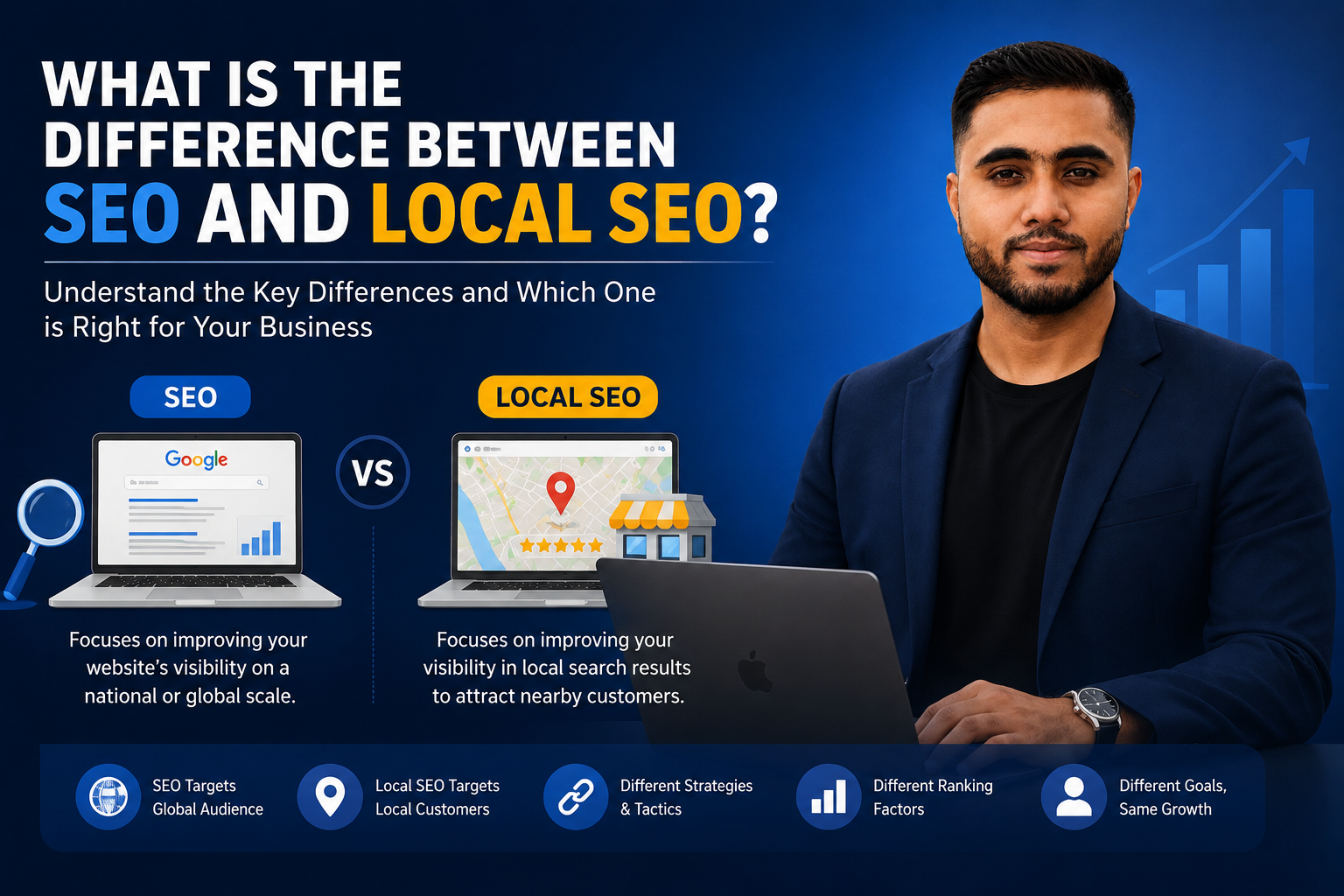
The main difference between SEO and local SEO is the type of search visibility they target.
SEO focuses on improving your website’s overall visibility in search results. Local SEO focuses on improving your visibility for searches connected to a specific location or service area.
Traditional SEO may target a broad keyword like “what is SEO.” Local SEO may target a more action-focused keyword like “SEO expert for small business near me.”
Another major difference is the search result format. SEO usually focuses on organic website rankings. Local SEO focuses on Google Maps, local packs, business profiles, reviews, and location pages.
The ranking factors are also different. General SEO depends heavily on website content, technical quality, backlinks, topical authority, page experience, and keyword relevance. Local SEO also includes factors like business location, reviews, Google Business Profile optimization, local citations, service area relevance, and local trust signals.
In simple words:
- SEO helps people find your website.
- Local SEO helps nearby customers find your business.
- SEO builds online authority.
- Local SEO builds local visibility and trust.
- SEO targets broader traffic.
- Local SEO targets local leads and calls.
- Both are valuable, but they serve different purposes.
SEO vs Local SEO Comparison
| Feature | SEO | Local SEO |
|---|---|---|
| Main Goal | Improve website rankings | Improve local and map visibility |
| Best For | Broad search traffic | Nearby customer leads |
| Search Intent | Informational, commercial, service-based | Local, high-intent, action-based |
| Main Platform | Website and Google organic results | Google Maps, Google Business Profile, local pages |
| Key Assets | Blog posts, service pages, backlinks | GBP, reviews, citations, local landing pages |
| Example Keyword | “What is SEO?” | “SEO expert near me” |
| Best Outcome | More traffic and authority | More calls, visits, bookings, and local leads |
Why Small Businesses Need Both SEO and Local SEO
Many small business owners think they need either SEO or local SEO. In reality, the best strategy is often to use both together.
SEO helps you build a strong website. It allows you to create helpful blog posts, service pages, guides, comparison articles, and educational content. This builds authority and helps customers trust your business before they contact you.
Local SEO helps you appear when people are ready to take action. It improves your chances of showing up when customers search for a service in their area.
For example, a small business owner may first search “what is the difference between SEO and local SEO” to understand the topic. Later, they may search “local SEO expert for small business” when they are ready to hire someone.
If your website has helpful SEO content and your local presence is optimized, you can appear at both stages of the customer journey.
This is why Shawon Kumar Diptao recommends building a strategy that includes both educational SEO content and local SEO optimization. One builds trust. The other brings local leads.
When SEO Is More Important
SEO is more important when your goal is to build long-term website authority, rank for educational topics, or attract visitors beyond one local area.
You may need traditional SEO if:
- You offer online services
- You want to rank for national or broad keywords
- You publish educational blog content
- You want to build topical authority
- You want more organic website traffic
- You need stronger service pages
- Your competitors have better website content
For example, if your business provides SEO consulting, content marketing, or digital strategy online, traditional SEO can help you reach customers who are not limited to one city.
SEO is also helpful for answering questions that customers search before they are ready to buy. These topics may include cost, comparisons, benefits, mistakes, checklists, and how-to guides.
When Local SEO Is More Important
Local SEO is more important when your business depends on customers from a specific city, town, neighborhood, or service area.
- You may need local SEO if:
- You serve local customers
- You have a physical location
- You want more calls from Google Maps
- You want to rank for “near me” searches
- You compete with nearby businesses
- You depend on reviews and local trust
- You offer appointment-based services
- You want to improve your Google Business Profile
Local SEO is especially important for service-based businesses such as marketing agencies, SEO consultants, contractors, dentists, lawyers, real estate professionals, cleaning companies, repair services, and home service providers.
If your competitors appear in Google Maps and your business does not, that is usually a local SEO problem.
Local Search Scenarios Where Local SEO Wins
Local SEO becomes powerful when customers are searching with urgency, location, and trust in mind.
Imagine a business owner notices their website is not ranking and searches for “SEO expert near me.” They do not want a general article. They want a real service provider they can contact.
Another customer may search for “best local SEO services for small businesses.” They may compare reviews, check Google Business Profiles, visit websites, and look for proof of experience.
A third customer may search for “why is my business not showing on Google Maps?” This is a troubleshooting query. A business with strong local SEO content can answer the question and guide the customer toward a service.
These local scenarios show why small businesses need more than general SEO. They need location-focused visibility, trust signals, and clear conversion paths.
Cost of SEO vs Local SEO for Small Businesses
The cost of SEO and local SEO depends on your goals, competition, website condition, location strategy, and how much work is needed.
SEO may cost more if your website needs a lot of technical fixes, new content, service page improvements, keyword research, competitor analysis, and backlinks. If your industry is competitive, SEO usually takes more time and effort.
Local SEO costs can depend on the number of locations, Google Business Profile condition, review strength, citation consistency, local content needs, and service area competition.
For example, a single-location small business may need Google Business Profile optimization, review strategy, local citations, and a few strong service pages. A multi-location business may need separate landing pages, location-specific content, and a more advanced local SEO structure.
Instead of asking only “how much does SEO cost,” small businesses should ask, “What work is needed to improve visibility, leads, and conversions?”
A proper SEO audit can identify whether your main problem is content, technical SEO, local visibility, weak reviews, poor keyword targeting, or low website authority.
Common Problems Small Businesses Face Without Local SEO
Many small businesses invest in a website but still struggle to get leads. This often happens because the website is not supported by local SEO.
One common problem is ranking for general keywords but not appearing in local searches. This means people may find your content, but nearby customers may not find your business when they are ready to buy.
Another common issue is an incomplete or poorly optimized Google Business Profile. If your business profile has missing services, weak descriptions, few reviews, outdated hours, or low-quality photos, customers may choose a competitor.
Inconsistent business information is also a problem. Your business name, address, phone number, website, and service details should be consistent across online directories and listings.
Thin local content can also hurt performance. A service page that only has a few lines of text is usually not enough. Your pages should explain what you do, who you help, where you serve, why customers trust you, and what steps they should take next.
Local SEO Maintenance Tips for Small Businesses
Local SEO is not something you set once and ignore. It needs regular updates and monitoring.
Start by keeping your Google Business Profile updated. Make sure your services, business hours, description, website link, phone number, and service areas are accurate.
Ask satisfied customers for honest reviews. Reviews help build trust and can improve how potential customers see your business. Respond to reviews professionally, whether they are positive or negative.
Update your website content regularly. Add helpful blog posts, improve old pages, and create internal links between related topics. For example, this article can link to your main SEO service page, local SEO service page, website audit page, or digital marketing consultation page.
Also, check your website’s technical health. Make sure pages load quickly, work well on mobile, and are easy to navigate.
A simple monthly maintenance checklist can include:
- Review Google Business Profile updates
- Check new reviews and respond
- Update service pages
- Publish one helpful blog post
- Fix broken links
- Review keyword rankings
- Check competitors
- Improve internal links
- Track calls and leads
Small updates over time can create strong long-term results.
How to Make This Blog GEO-Focused Without Mentioning a City
Even if you do not want to mention a specific city in the title, you can still make your content GEO-focused by adding service-area relevance in the body content, internal links, and supporting pages.
For example, you can create separate pages for each service area and link to them from this blog. You can also mention examples like “your local market,” “your service area,” “nearby customers,” or “businesses in your region.”
This keeps the blog broad enough to target the main keyword while still supporting local SEO.
You can also add a local section later if needed, such as:
- “SEO vs Local SEO for Small Businesses in [City]”
- “How Local Search Works in [Service Area]”
- “Why Businesses in [Location] Need Local SEO”
- “Common Local Ranking Problems in [City]”
This approach helps the blog support your main service pages without making the content feel forced.
When to Call a Professional SEO Expert
You should call a professional SEO expert when your website is not ranking, your local competitors appear above you, or your Google Business Profile is not generating calls.
You may also need expert help if you are publishing content but not getting leads, your website has technical issues, your pages are not indexed, or you are unsure which keywords to target.
A professional can help you find the real reason your business is not performing well in search. Sometimes the issue is not content. It may be technical SEO, poor internal linking, weak local signals, bad keyword targeting, or low trust.
Working with an expert can save time because you get a clear strategy instead of guessing.
Why Choose Shawon Kumar Diptao for SEO and Local SEO?
Shawon Kumar Diptao helps small businesses build SEO strategies that are practical, clear, and focused on growth. The goal is not only to rank for keywords but to attract the right people, answer real customer questions, and turn traffic into leads.
With experience in SEO, local SEO, AEO, GEO-focused content, and service page optimization, Shawon Kumar Diptao can help your business build a stronger search presence.
Whether you need keyword research, blog content, local SEO planning, Google ranking support, internal linking, or website optimization, a structured strategy can make your business easier for both Google and customers to understand.
If you want to improve your website visibility and local search performance, visit Shawon Kumar Diptao
Final Thoughts
So, what is the difference between SEO and local SEO?
SEO helps your website rank in regular search results. Local SEO helps your business appear in location-based searches, Google Maps, and nearby customer searches.
For small businesses, both are important. SEO helps build authority and long-term visibility. Local SEO helps attract nearby customers who are ready to call, visit, book, or buy.
The best strategy is not SEO vs local SEO. The best strategy is using both together.
When your website content, service pages, Google Business Profile, reviews, local citations, and internal links all work together, your business has a much better chance of ranking on Google, appearing in AI-powered search results, and turning search visibility into real leads.
FAQs
Q. What is the main difference between SEO and local SEO?
Answer: SEO helps your website rank in general Google search results, while local SEO helps your business appear in location-based searches, Google Maps, and “near me” results.
Q. Does my small business need SEO or local SEO first?
Answer: If your business serves a local area, start with local SEO and basic website SEO together. This helps nearby customers find you while also improving your website’s overall search performance.
Q. How long does local SEO take to work?
Answer: Local SEO can show early improvements within a few weeks, but stronger results usually take 3 to 6 months depending on competition, reviews, content quality, and Google Business Profile optimization.
Q. Is Google Business Profile part of local SEO?
Answer: Yes. Google Business Profile is one of the most important parts of local SEO because it helps your business appear in Google Maps, local results, and nearby customer searches.
Q. Can SEO help my business rank in Google AI Overviews?
Answer: Yes. Clear, helpful, well-structured SEO content can improve your chances of being understood by search engines and AI-powered search results. Strong headings, direct answers, expertise, and useful content are important.