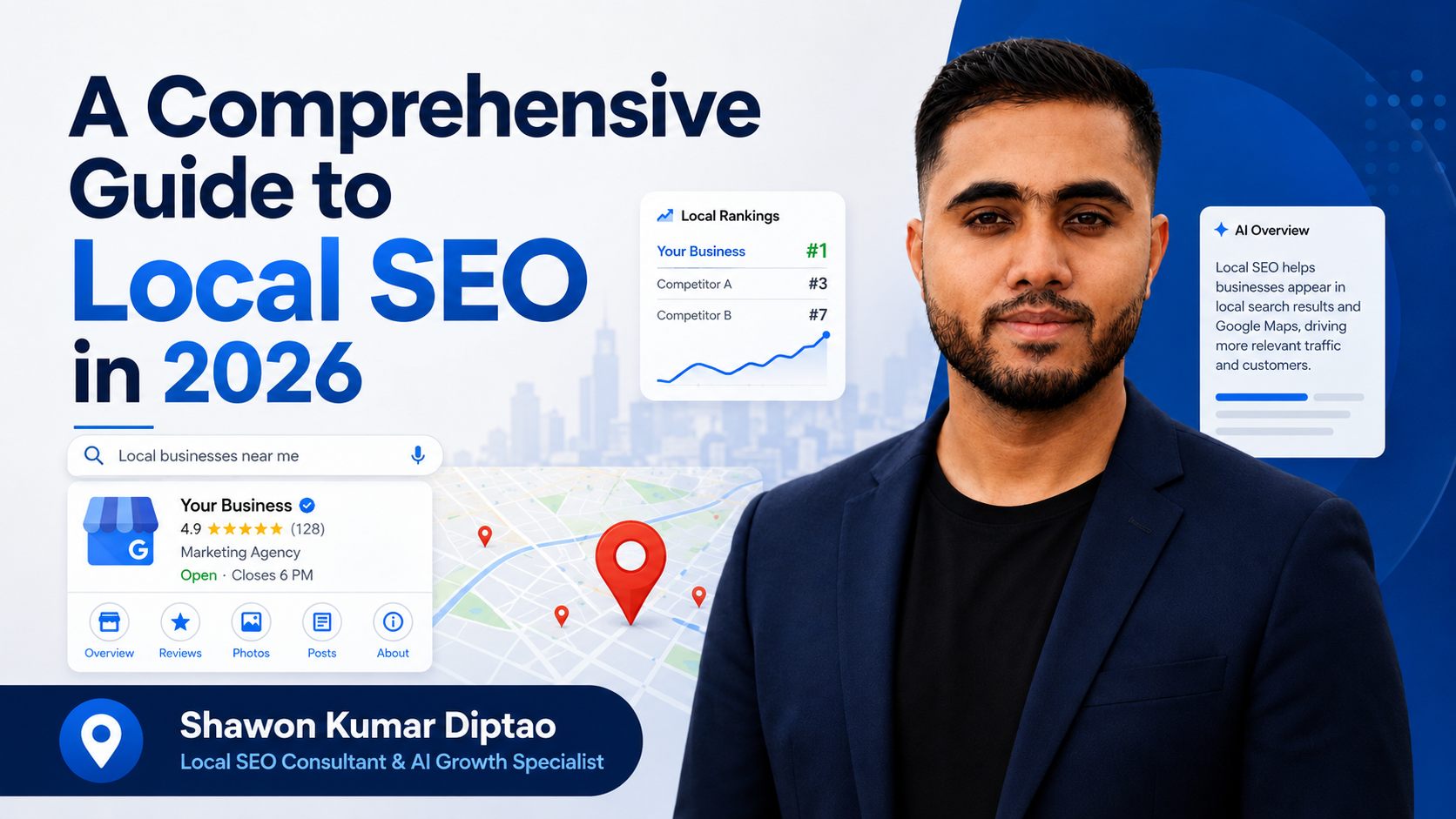
A Comprehensive Guide to Local SEO in 2026: How Businesses Can Rank on Google and AI Overviews
Local SEO in 2026 is the process of making a business easy to find, understand, and trust when potential customers search for nearby products or services. To rank in Google Search, Google Maps, local results, and AI Overviews, businesses need accurate information, relevant service content, a well-optimized Google Business Profile, genuine reviews, local authority, and a technically sound website.
The biggest change is not that traditional SEO has disappeared. Instead, local search now includes more conversational queries, AI-generated summaries, comparison searches, and highly specific questions.
A customer may no longer search only for “SEO services near me.” They may ask:
- Which local SEO company is best for a service-area business?
- How much does local SEO cost for a small business?
- Why is my business not showing in Google Maps?
- How can my website appear in Google AI Overviews?
- Is local SEO worth paying for in 2026?
Businesses that answer these questions clearly and demonstrate real expertise have a stronger opportunity to gain visibility across traditional and AI-powered search experiences.
This comprehensive guide to local SEO in 2026 explains how to build that visibility sustainably.
What Is Local SEO in 2026?
Local SEO is a digital marketing strategy that helps a business appear when people search for services within a particular location or service area.
It includes:
- Google Business Profile optimization
- Google Maps ranking improvements
- Local keyword research
- Service and location page optimization
- Local citation management
- Review generation and reputation management
- NAP consistency
- Local link building
- LocalBusiness structured data
- Answer Engine Optimization
- Generative Engine Optimization
- Technical and mobile SEO
NAP refers to the business’s name, address, and phone number. Keeping this information accurate across the website, Google Business Profile, social platforms, and important directories helps customers and search engines understand that each listing represents the same business.
Local SEO is especially important for businesses that depend on nearby customers, including professional service providers, contractors, consultants, agencies, healthcare providers, retailers, restaurants, and service-area companies.
How Does Google Rank Local Businesses?
Google explains that local results are primarily based on relevance, distance, and prominence. These signals work together to help Google identify which businesses are likely to satisfy a local search.
Understanding these three factors is essential for anyone who wants to rank on Google Maps or improve local organic visibility.
Relevance
Relevance measures how closely a business matches what the customer is searching for.
A business can improve relevance by:
- Selecting accurate Google Business Profile categories
- Listing its individual services
- Creating a page for every major service
- Using clear page titles and headings
- Answering common customer questions
- Describing the problems each service solves
- Adding accurate service-area information
For example, an SEO consultant should not rely on a homepage that simply says “digital marketing services.” The website should clearly explain services such as local SEO, technical SEO, Google Business Profile optimization, keyword research, content strategy, and AI search optimization.
Specificity helps both customers and search engines understand what the business offers.
Distance
Distance considers how far the business is from the location used in the search.
A customer may specify a place, such as “SEO consultant in my area,” or Google may estimate local intent from the customer’s device location.
Businesses cannot safely manipulate proximity. The best approach is to provide truthful location and service-area information.
A service-area business should explain:
- Which areas it serves
- Whether services are delivered remotely or in person
- Typical response or appointment times
- Any travel limitations
- Whether additional charges apply outside the primary service area
Creating pages for locations the business does not genuinely serve can damage trust and result in low-quality, repetitive content.
Prominence
Prominence reflects how well known and credible the business appears.
Google may evaluate information such as reviews, links, articles, directories, and a business’s general visibility across the web. A company with a strong reputation, consistent listings, useful website content, and relevant mentions may appear more prominent than a competitor with little supporting information.
Prominence can be strengthened through:
- Genuine customer reviews
- Relevant business directory listings
- Local media coverage
- Partnerships and professional associations
- Links from suppliers or community organizations
- Authoritative educational content
- Consistent brand information
- Strong organic search performance
Prominence takes time to build. It should be treated as a reputation strategy rather than a quick ranking trick.
How Can a Business Appear in Google AI Overviews?
Google AI Overviews generate summaries for certain searches and may include links that allow users to explore supporting information.
There is no guaranteed method for being selected. However, Google’s current guidance says that its generative AI search experiences are built on its existing Search ranking and quality systems. Foundational SEO remains relevant for AI Overviews and other generative search features.
Businesses should therefore focus on becoming a reliable source rather than searching for a separate collection of AI-ranking hacks.
Provide the Direct Answer First
AEO-friendly content should answer the main question near the beginning of the page or section.
For example:
How can a business improve its local Google ranking?
A business can improve its local ranking by completing its Google Business Profile, creating relevant service pages, earning genuine reviews, correcting inconsistent listings, building local authority, and maintaining a crawlable, mobile-friendly website.
The rest of the section can then explain each step in detail.
This structure helps readers obtain a quick answer while still providing enough depth for people who need further guidance.
Cover the Entire Decision Journey
Customers ask different questions depending on how close they are to purchasing.
Early-stage questions may include:
- What is local SEO?
- How does Google Maps ranking work?
- Is SEO still important for AI search?
Comparison-stage questions may include:
- Local SEO versus traditional SEO: what is the difference?
- Should I hire an agency or an independent consultant?
- Is SEO or paid advertising better for a local business?
High-intent questions may include:
- How much does local SEO cost?
- How long will it take to see results?
- Which local SEO service is right for my business?
Publishing content for each stage creates more opportunities to appear for long-tail searches and guide users toward an enquiry.
Demonstrate Firsthand Expertise
Generic content is easy to produce. Expert content provides something more useful.
A strong local SEO article may include:
- Firsthand observations
- Screenshots from actual tools
- Original checklists
- Before-and-after examples
- Explanations of common mistakes
- Industry-specific recommendations
- Quotes from qualified professionals
- Clearly stated limitations
- Updated information
Google’s people-first content guidance emphasizes creating reliable, useful information for people rather than publishing primarily to manipulate rankings.
Every article should therefore answer a genuine customer need.
A Complete Local SEO Strategy for 2026
Successful local SEO is not based on one ranking factor. It requires several connected activities.
1. Optimize the Google Business Profile
The Google Business Profile is one of the most important assets for local visibility.
Complete every applicable section, including:
- Real-world business name
- Primary category
- Secondary categories
- Address or service area
- Phone number
- Website
- Opening hours
- Holiday hours
- Services
- Appointment links
- Business description
- Photos
- Relevant attributes
Choose categories based on what the business actually is, not every keyword it wants to rank for.
Avoid adding keywords to the business name unless they are genuinely part of the registered and publicly used name. Keyword-stuffed names can create policy and trust problems.
The profile should also remain active and accurate. Update changed hours, outdated services, broken links, and old images as soon as possible.
2. Build a Strong Page for Every Main Service
A homepage rarely contains enough information to rank competitively for every service.
Create dedicated pages for high-value services. Each page should explain:
- What the service is
- Who needs it
- Which problems it solves
- What the process includes
- Expected outcomes
- Relevant service areas
- Common questions
- Why the business is qualified
- What the customer should do next
A local SEO service page could include sections covering Google Business Profile optimization, citation cleanup, review strategy, local keyword research, service-area content, schema implementation, and reporting.
These pages should be connected with contextual internal links. Businesses looking for strategic assistance can explore the local SEO and AI search optimization services offered by Shawon Kumar Diptao.
3. Create GEO-Focused Content Without Location Stuffing
GEO-focused content connects a service with a real geographical market.
When no single city is being targeted, build content around authentic service areas and local customer scenarios.
Useful local information may include:
- Differences in demand across service areas
- Local customer expectations
- Seasonal changes in enquiries
- Response-time limitations
- Local regulations or requirements
- Common property or business types
- Regional terminology
- Area-specific service challenges
Do not insert dozens of place names into paragraphs simply to create the appearance of local relevance.
Location references should help the customer make a decision.
4. Create Unique Service-Area Pages
A service-area page can help customers understand whether a business is available in their location. However, each page must offer genuine value.
A useful location page may contain:
- Services available in the area
- Relevant customer problems
- Service limitations
- Expected response times
- Local testimonials
- Completed project examples
- Area-specific FAQs
- Directions or appointment information
- A clear contact method
Avoid duplicating the same text across dozens of pages and changing only the location name. These doorway-style pages provide little value and may weaken the overall quality of the website.
5. Strengthen Internal Linking
Internal links help users and search engines move between related pages.
Every informational article should link to the most relevant commercial service page. Service pages can also link to supporting guides, case studies, FAQs, and contact pages.
Useful internal-link anchor text may include:
- Local SEO services
- Google Business Profile optimization
- Improve Google Maps visibility
- AI Overview optimization
- SEO services for local businesses
- Local keyword research
- Professional SEO audit
- Service-area SEO strategy
Avoid repeatedly using an exact-match keyword in every internal link. Natural variation creates a better reading experience.
6. Earn Genuine Customer Reviews
Reviews influence customer trust and can support local prominence.
Ask customers for honest feedback shortly after completing a service. Make the process simple by providing a direct review link, but do not pressure customers to leave only positive ratings.
Respond to positive and negative reviews professionally.
A useful response should:
- Thank the customer
- Refer naturally to the service
- Address concerns without becoming defensive
- Avoid revealing private information
- Explain the next step when a problem needs attention
Never purchase reviews or offer rewards in exchange for positive ratings.
7. Correct Local Citations and NAP Inconsistencies
A local citation is an online reference to a business’s identifying information.
Audit important listings for:
- Misspelled business names
- Old phone numbers
- Previous addresses
- Incorrect URLs
- Duplicate profiles
- Inaccurate opening hours
- Wrong categories
Prioritize respected platforms, industry directories, professional organizations, and resources that customers actually use.
Submitting a business to hundreds of unrelated directories is unlikely to be as valuable as maintaining accurate information on a smaller number of trusted platforms.
8. Add LocalBusiness Structured Data
Structured data provides search engines with machine-readable information about a page or business.
LocalBusiness structured data can communicate details such as business type, address, opening hours, telephone number, and other relevant information. Google recommends using the most specific applicable business type and ensuring that marked-up details match the visible content.
Structured data can improve understanding, but it does not guarantee rankings or a particular search feature.
After implementation:
- Validate the markup.
- Correct critical errors.
- Confirm that the page is indexable.
- Keep the structured data synchronized with the website and Business Profile.
How Much Does Local SEO Cost in 2026?
The cost of local SEO depends on the condition of the website, market competition, number of services, number of locations, and amount of ongoing work required.
A smaller campaign may include:
- Local SEO audit
- Google Business Profile optimization
- Keyword research
- On-page improvements
- Citation corrections
- Basic reporting
A competitive campaign may also require:
- Technical SEO repairs
- Multiple service pages
- Unique location pages
- Review strategy
- Digital PR or link acquisition
- Content production
- Conversion optimization
- Ongoing analysis
One-time projects cost less initially, but local SEO usually requires continuing maintenance.
Businesses should be cautious of providers who:
- Guarantee the number-one ranking
- Promise instant results
- Sell fake reviews
- Create unauthorized profiles
- Refuse to explain their methods
- Publish hundreds of duplicated location pages
- Claim they can pay Google for higher local rankings
Google states that businesses cannot request or pay for a better local ranking.
The best provider is not automatically the cheapest or most expensive. Choose someone who can explain the strategy, connect SEO activity with business outcomes, and report honestly on progress.
Why Is My Business Not Ranking Locally?
A business may have a website and verified profile but still struggle to rank.
Common causes include:
- Incorrect Google Business Profile categories
- Incomplete business information
- Weak or generic service pages
- Inconsistent NAP information
- Few trustworthy reviews
- Low local authority
- Duplicate business profiles
- Pages blocked from indexing
- Poor mobile usability
- Slow page performance
- Weak internal linking
- Stronger competitors
- Location pages with duplicated content
Use the following troubleshooting checklist:
- Confirm that the Business Profile is verified and publicly visible.
- Review the primary and secondary categories.
- Check opening hours, phone numbers, links, and service areas.
- Inspect important URLs in Google Search Console.
- Confirm that service pages match customer search intent.
- Compare your content, reviews, and authority with local competitors.
- Search for duplicate or outdated business listings.
- Test the website on mobile devices.
- Track rankings from more than one point in the service area.
- Fix the largest problem before creating more content.
Do not assume that publishing additional articles will solve every ranking problem. A suspended profile, indexing error, or weak service page requires a specific solution.
Local SEO Maintenance and Prevention Tips
Local SEO should be maintained continuously.
Monthly Checklist
- Review Google Business Profile information
- Respond to new reviews
- Check website forms and phone links
- Update special opening hours
- Review Search Console errors
- Check important rankings
- Monitor duplicate listings
- Add new photos where appropriate
- Review leads generated by local search
Quarterly Checklist
- Refresh important service pages
- Review local search queries
- Update outdated FAQs
- Audit internal links
- Check structured data
- Evaluate review growth
- Compare performance with competitors
- Update service-area information
- Review calls, enquiries, and conversions
Create a simple change log showing profile edits, new pages, citation fixes, links, reviews, and technical changes. This makes it easier to understand why visibility improved or declined.
When Should You Call a Local SEO Professional?
Consider professional help when:
- Your rankings suddenly decline
- Your Google Business Profile is suspended
- Important pages are not being indexed
- Competitors dominate your main searches
- You manage several business locations
- Business information is inconsistent
- Organic traffic does not generate leads
- Your team lacks time to manage local SEO
- You are unsure how to optimize for AI search
- Previous SEO work created technical or policy problems
An experienced professional can identify whether the main obstacle involves relevance, proximity, prominence, website quality, technical SEO, reputation, or competition.
Why Choose Shawon Kumar Diptao?
Shawon Kumar Diptao helps businesses develop practical SEO and marketing strategies designed around visibility, trust, and sustainable growth.
Instead of relying on shortcuts, the process can address the complete search journey, including:
- Local SEO strategy
- Google Business Profile optimization
- Service-page planning
- Local keyword research
- Content optimization
- Answer Engine Optimization
- AI search visibility
- Internal linking
- Technical SEO guidance
- Performance analysis
The goal is not merely to generate rankings. It is to connect relevant searches with useful pages and turn qualified visibility into meaningful business enquiries.
Learn more about working with Shawon Kumar Diptao to improve your presence across Google Search, local results, Google Maps, and AI-powered search experiences.
Frequently Asked Questions About Local SEO in 2026
How can a local business rank on Google in 2026?
A local business can improve its rankings by completing its Google Business Profile, creating useful service pages, maintaining accurate business information, earning genuine reviews, building trusted local mentions, and keeping its website technically healthy. The business must also demonstrate relevance to the service and area being searched.
Can local SEO help a business appear in Google AI Overviews?
Yes. Local SEO can support AI Overview visibility by making a business and its content easier for Google to find, understand, and trust. Clear answers, expert content, accurate business data, strong organic SEO, and authoritative mentions can improve eligibility, although inclusion is never guaranteed.
How long does local SEO take to produce results?
Some corrections, such as fixing inaccurate profile details, may create improvements relatively quickly. Competitive rankings often require several months of consistent work because results depend on competition, website authority, reviews, content quality, location, and the severity of existing problems.
Do service-area businesses need separate location pages?
Service-area businesses may benefit from location pages when each page contains useful, unique, and truthful information. A page should explain local availability, relevant services, common customer problems, response expectations, proof of work, and area-specific FAQs. Pages that merely swap location names are unlikely to provide meaningful value.
Is Google Business Profile optimization enough for local SEO?
No. Google Business Profile optimization is important, but it is only one part of local SEO. Rankings may also depend on website content, organic search performance, customer reviews, business citations, links, structured data, technical quality, internal linking, competition, and proximity.
Build a Stronger Local Search Presence in 2026
Local SEO in 2026 is not about repeating a city name or publishing large numbers of generic articles. It is about presenting a clear, accurate, and trustworthy business identity wherever customers search.
Complete your Google Business Profile. Build detailed service pages. Answer real customer questions. Maintain accurate listings. Earn genuine reviews. Add useful local context. Strengthen technical SEO. Measure calls and enquiries—not rankings alone.
Businesses that follow these principles will be better positioned to appear in Google Search, Google Maps, long-tail question results, and AI-powered search experiences.
For a tailored local SEO and AI search strategy, contact Shawon Kumar Diptao and take the next step toward stronger visibility, qualified traffic, and sustainable digital growth.