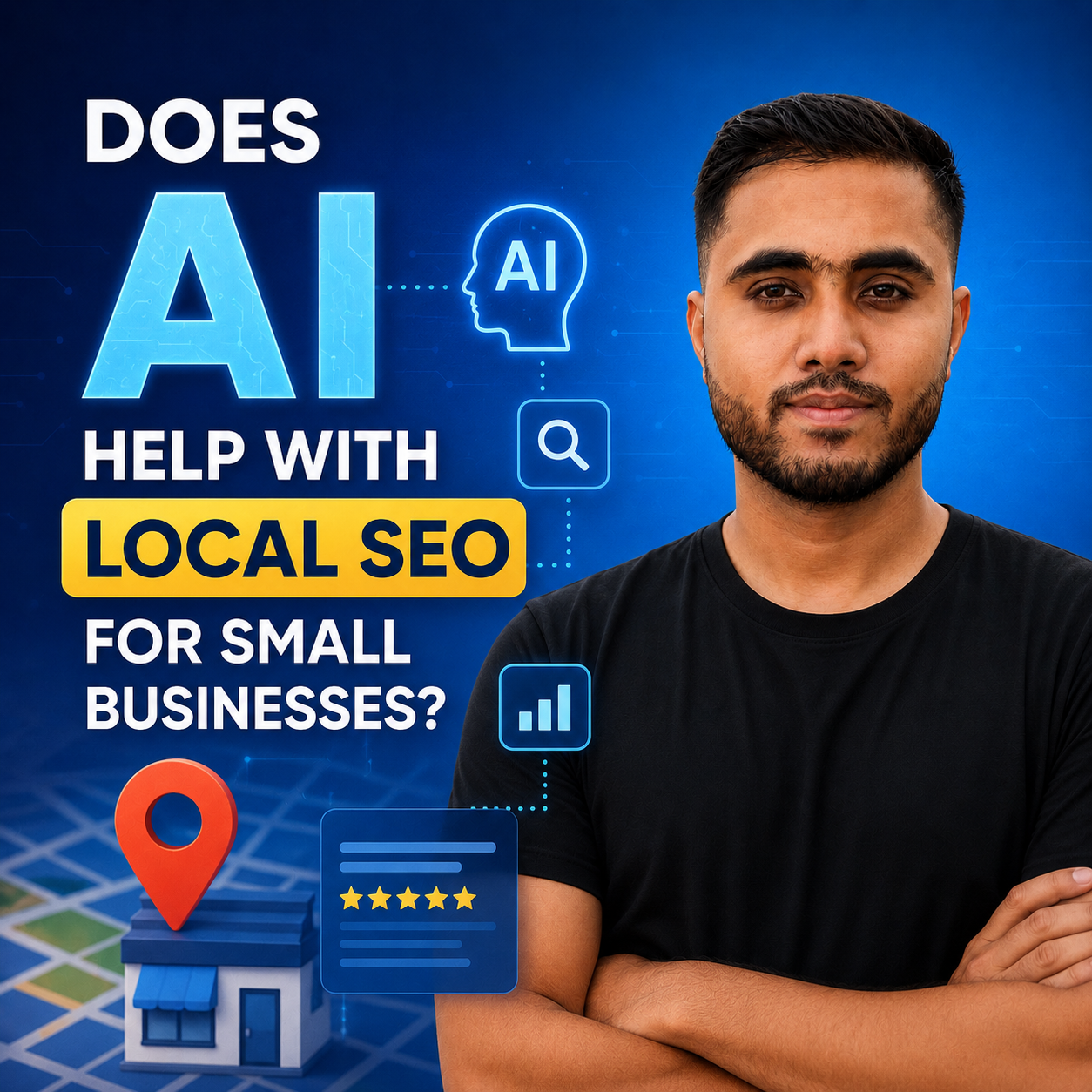
Does AI Help With Local SEO for Small Businesses Trying to Rank on Google?
Yes, AI does help with local SEO for small businesses trying to rank on Google, but it should not be treated as a complete replacement for expert SEO strategy. AI can speed up keyword research, content planning, competitor analysis, Google Business Profile content, FAQ writing, and answer-focused optimization. However, real local SEO still needs human judgment, business knowledge, local market understanding, technical SEO, review strategy, and consistent optimization.
For small businesses, the best use of AI is not simply asking a tool to write random blog posts. The real value comes when AI is used to support a smart local SEO strategy. That means creating helpful content, targeting the right local search intent, improving website structure, supporting main service pages, and answering the questions real customers are already searching for.
If your goal is to rank on Google, appear in local search results, improve visibility in Google Maps, and increase your chances of showing in Google AI Overviews, AI can be a powerful advantage. But it must be used correctly.
What Does AI Do for Local SEO?
AI helps local SEO by making the research and content process faster. A small business can use AI to find long-tail keywords, organize blog topics, write first drafts, create FAQs, summarize customer pain points, and improve page structure.
For example, instead of only targeting a broad keyword like “SEO services,” AI can help identify more specific search queries such as:
- “does AI help with local SEO for small businesses”
- “how can small businesses rank on Google”
- “how to improve local search visibility”
- “best local SEO strategy for small business owners”
- “how to use AI for Google Business Profile optimization”
These long-tail keywords are valuable because they match the way customers ask questions. They are also useful for AEO, which means Answer Engine Optimization. AEO focuses on giving clear, direct answers that search engines and AI tools can understand.
However, AI is only helpful when the information is reviewed, improved, and connected to a real SEO goal. If a business publishes generic AI content without expert editing, the content may sound polished but fail to rank, fail to convert, or fail to build trust.
Why Local SEO Matters for Small Businesses
Local SEO matters because most small businesses do not need random traffic from everywhere. They need visibility in front of people who are likely to call, visit, book, request a quote, or buy.
A small business may want to rank for service-based searches, “near me” searches, Google Maps results, and location-based organic rankings. Even if a business does not mention a city in every blog title, Google still looks for local relevance across the website, Google Business Profile, reviews, citations, service pages, and content.
Strong local SEO can help a business appear when potential customers search for things like:
- “SEO expert for small business”
- “local SEO consultant”
- “Google Business Profile optimization”
- “small business marketing help”
- “AI SEO strategy”
- “rank my business on Google”
Today, local SEO is not only about ranking a homepage. A business needs optimized service pages, helpful blog posts, accurate business information, strong internal links, review signals, and content that answers real customer questions.
This is where AI can help, but only when it is guided by strategy.
How AI Helps Small Businesses Rank on Google
AI can support several important parts of local SEO.
1. AI Helps With Local Keyword Research
Keyword research is one of the first steps in SEO. AI can help generate keyword ideas based on services, customer problems, search intent, and local buying behavior.
For example, a small business owner may not know whether to target “SEO services,” “local SEO for small businesses,” or “does AI help with local SEO for small businesses.” AI can help organize these keywords into informational, commercial, and service-based categories.
This makes it easier to build a content plan that supports ranking and lead generation.
2. AI Helps Create Better Blog Topics
Small businesses often struggle to know what to publish. AI can help turn customer questions into SEO-friendly blog topics.
Instead of writing a generic blog like “SEO Tips for Business,” a stronger title would be “Does AI Help With Local SEO for Small Businesses Trying to Rank on Google?” This title is specific, question-based, and aligned with AEO.
Good blog topics should support main service pages. For example, a blog about AI and local SEO can internally link to a main SEO service page, Google Business Profile optimization page, or small business SEO consultation page.
3. AI Helps Improve Google Business Profile Content
Google Business Profile is a major part of local SEO. AI can help write business descriptions, service descriptions, posts, updates, product descriptions, and review response drafts.
For example, a small business can use AI to create weekly Google Business Profile posts about services, offers, case studies, customer questions, or seasonal updates.
However, AI-generated GBP content should always be edited. It should sound natural, match the real business, and avoid exaggeration.
4. AI Helps With Competitor Research
AI can help organize competitor research by comparing website pages, blog topics, headings, service descriptions, FAQs, and content gaps.
A small business can use AI to ask:
- “What topics are competitors covering?”
- “What questions are they answering?”
- “What service pages do they have?”
- “What content gaps can we target?”
But AI should not be the only source of truth. Competitor research still needs manual review because rankings depend on many factors, including backlinks, reviews, proximity, authority, website quality, and user experience.
5. AI Helps Create AEO-Friendly Answers
Google AI Overviews and other AI-generated answer tools often prefer content that gives clear, direct, structured answers. AI can help format blog sections with short answers, FAQs, and question-based headings.
For example, a section titled “Does AI help with local SEO for small businesses?” should answer the question directly in the first sentence. This improves the chance that search engines and AI systems understand the content.
Local SEO Problems AI Can Help Identify
Many small businesses face common local SEO problems. AI can help organize these issues, but an expert is needed to fix them properly.
One common issue is weak local visibility. A business may have a website but still not appear for important local searches. This can happen when service pages are thin, Google Business Profile is incomplete, reviews are weak, or content does not match local search intent.
Another problem is poor keyword targeting. Some businesses only target broad keywords, while ignoring long-tail local keywords that are easier to rank for and more likely to convert.
A third issue is inconsistent business information. If your business name, phone number, website, services, or address details are different across platforms, Google may have less confidence in your business.
Small businesses also struggle with generic content. Many websites have pages that say similar things as every competitor. AI can help create a better structure, but expert input is needed to add unique experience, real examples, and business-specific value.
GEO SEO Without Forcing a City Name
Since this blog does not target one specific city, the GEO strategy should focus on service-area relevance. That means the content should still speak to local business owners, local customers, nearby search behavior, and Google Maps visibility without forcing an unnecessary city name.
Useful GEO-focused phrases include:
- local service area
- nearby customers
- local search visibility
- Google Maps rankings
- near me searches
- local competitors
- service-area SEO
- local business rankings
This approach keeps the content flexible while still supporting local ranking. If the business later creates city-specific pages, this blog can internally link to those pages.
The key is to avoid location stuffing. Google does not need a city name repeated again and again. It needs clear service relevance, helpful content, trustworthy business information, and strong local signals.
Is AI Local SEO Cheaper Than Hiring an SEO Expert?
AI tools are often cheaper than hiring an SEO expert, but cheaper does not always mean better. Free and paid AI tools can help with research, writing, brainstorming, and content formatting. For a small business with a limited budget, this can be useful.
But AI-only SEO has risks. It may create content that looks good but does not rank. It may miss technical SEO problems. It may produce weak internal links. It may ignore conversion strategy. It may also create content that is too generic to compete in local search.
An SEO expert looks at the full picture. That includes your website structure, keyword strategy, service pages, content quality, Google Business Profile, local citations, reviews, competitors, and lead generation goals.
The best approach is often a combination: use AI for speed and use an SEO professional for strategy.
Expert Checklist: How to Use AI for Local SEO Correctly
Before publishing AI-assisted local SEO content, use this checklist:
- Make sure the blog answers one clear question.
- Use the target keyword naturally.
- Add related keywords without stuffing.
- Include a direct answer near the beginning.
- Use H2 and H3 headings clearly.
- Add FAQs for AEO.
- Link to a main service page.
- Add local search context.
- Review all facts manually.
- Make the content helpful for real customers.
- Avoid publishing AI content without human editing.
Also check your Google Business Profile. Make sure your categories, services, description, photos, opening hours, website link, and contact details are accurate. AI can help write content, but it cannot replace accurate business information.
Maintenance Tips for Local SEO Rankings
Local SEO needs regular maintenance. Even if your website starts ranking, competitors can update their pages, publish stronger content, gain better reviews, or improve their Google Business Profile.
To maintain rankings, update old blog posts with fresh information, stronger answers, and better internal links. Review your service pages regularly. Add new FAQs when customers ask new questions.
Monitor Google Search Console to see which queries bring impressions and clicks. Check your Google Business Profile data to understand calls, website visits, direction requests, and profile interactions.
Respond to reviews consistently. Publish Google Business Profile updates. Keep your business information accurate across online directories.
AI can help with these tasks, but the strategy should stay human-led.
When to Call a Professional for Local SEO
You should call a professional when your business is not ranking on Google even after publishing content. This may mean your website has deeper problems, such as poor technical SEO, weak service pages, low authority, or poor internal linking.
You should also get expert help if your Google Business Profile gets views but does not generate calls or inquiries. That may mean your profile is visible but not convincing enough.
If your AI-generated content is not bringing traffic, leads, or rankings, it is time to review the strategy. The problem may not be the writing. It may be the keyword targeting, content structure, search intent, internal links, or service page connection.
A professional local SEO consultant can help connect every part of your search visibility system.
Why Choose Shawon Kumar Diptao for Local SEO and AI SEO Strategy
Shawon Kumar Diptao helps small businesses use SEO, local search strategy, and AI-assisted content in a smarter way. The goal is not to publish random AI articles. The goal is to build a ranking system that supports visibility, authority, and leads.
With Shawon Kumar Diptao, small businesses can get a strategy focused on local SEO, AEO, Google rankings, Google Business Profile optimization, service page support, and long-tail content planning.
The approach is simple: use AI where it saves time, use SEO expertise where strategy matters, and create content that answers real customer questions.
If you want expert help with AI SEO, local SEO, small business SEO, or Google ranking strategy, visit Shawon Kumar Diptao to learn more.
Final Answer: Does AI Help With Local SEO for Small Businesses?
Yes, AI helps with local SEO for small businesses trying to rank on Google. It can speed up keyword research, content planning, FAQ creation, competitor analysis, Google Business Profile content, and AEO optimization.
But AI is not a complete local SEO strategy by itself. To get real results, small businesses need expert direction, helpful content, accurate local signals, strong service pages, technical SEO, reviews, and consistent optimization.
AI is a tool. Strategy is what makes it work.
When both are combined, small businesses can improve local visibility, support main service pages, rank for long-tail questions, and build a stronger presence on Google.
FAQs About AI and Local SEO for Small Businesses
Does AI help with local SEO for small businesses?
Yes. AI helps with local SEO by supporting keyword research, content planning, FAQ writing, Google Business Profile content, and competitor analysis. It works best when guided by an SEO expert.
Can AI help my small business rank on Google?
AI can support your ranking strategy, but it cannot guarantee rankings. Your website still needs helpful content, technical SEO, strong service pages, reviews, local authority, and proper optimization.
Is AI content good for local SEO?
AI content can be good for local SEO if it is edited, fact-checked, localized, and improved with expert insight. Generic AI content without human review is less likely to perform well.
How can AI improve Google Business Profile optimization?
AI can help write Google Business Profile posts, service descriptions, business updates, review responses, and FAQ-style content. However, all content should be reviewed before publishing.
Should small businesses use AI or hire an SEO expert?
Small businesses should use both when possible. AI can save time, but an SEO expert can build the strategy, fix ranking problems, improve local relevance, and turn traffic into leads.