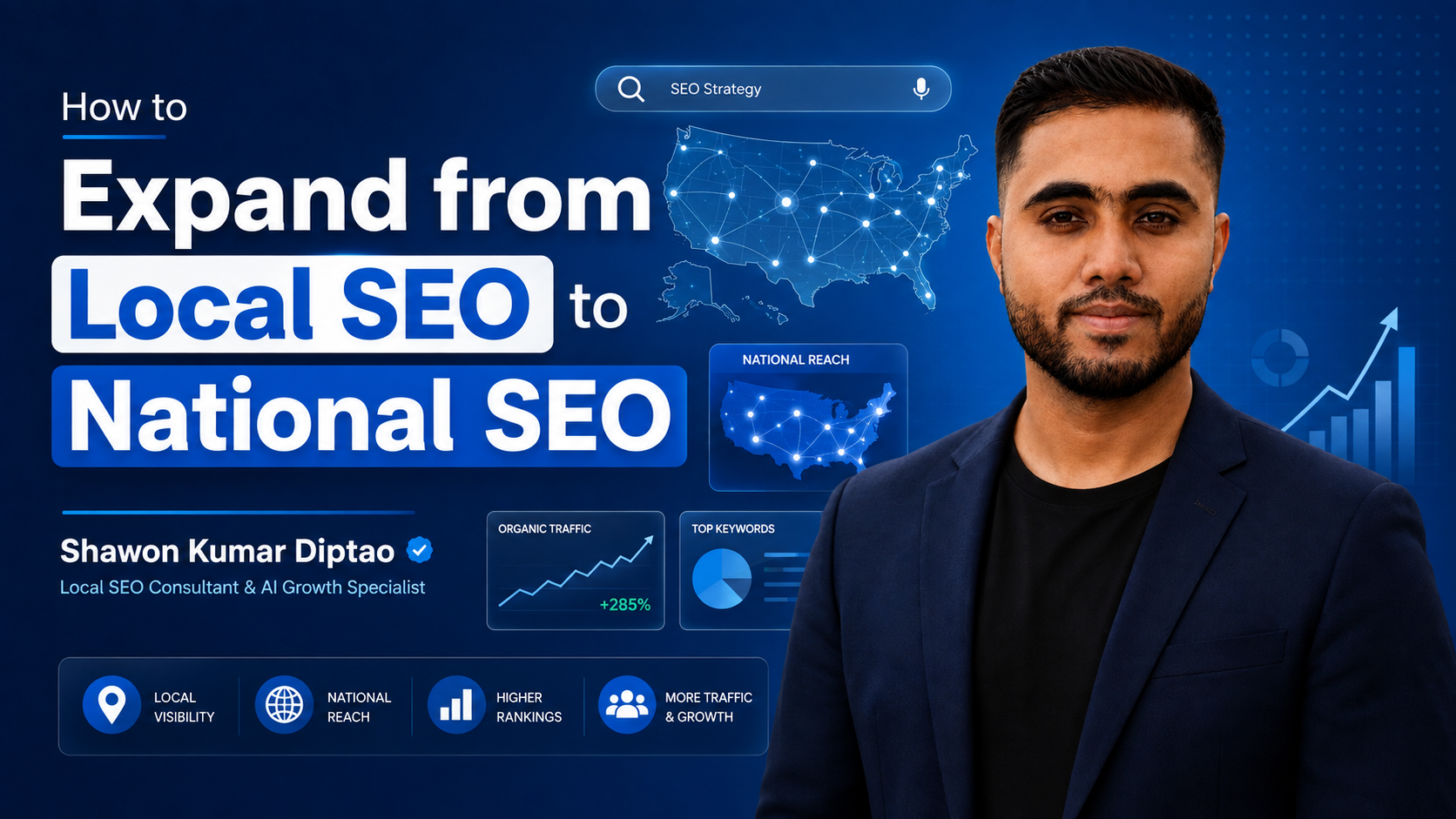
How to Expand From Local SEO to National SEO Without Losing Local Rankings
You can expand from local SEO to national SEO without losing your existing local rankings by keeping your strongest local assets intact and building a separate national search strategy around them. This means preserving successful location pages, separating local and national keywords, improving your website structure, publishing broader content, and monitoring each market independently.
The goal is not to replace local SEO. It is to use your existing local authority as the foundation for wider growth.
A business that expands too quickly may remove important location signals, create competing pages, or redirect authority away from its highest-converting local content. A carefully planned local SEO to national SEO strategy, however, can increase national organic visibility while continuing to generate local calls, enquiries, store visits, and leads.
This guide explains how to expand from local SEO to national SEO safely, step by step.
What Is the Difference Between Local SEO and National SEO?
Local SEO helps a business appear when someone searches for a service within a specific geographic area. It commonly focuses on:
- Google Business Profile visibility
- Google Maps rankings
- Location-based keywords
- Local service pages
- Customer reviews
- Business citations
- Nearby search intent
National SEO targets a much wider audience. It focuses less on a single location and more on broad services, industries, customer problems, product categories, and informational questions.
For example:
- “SEO consultant near me” has strong local intent.
- “SEO consultant for ecommerce businesses” has broader commercial intent.
- “How to improve national organic visibility” has national informational intent.
The difference is not simply whether a city name appears in the keyword. The real difference is what the searcher needs and which type of page can satisfy that need.
Businesses interested in this distinction can read more about the difference between local and organic SEO.
Can Local SEO and National SEO Work Together?
Yes. Local and national SEO can work together when each strategy has its own keywords, landing pages, content, and conversion goals.
Your local SEO pages should continue targeting customers within the areas you currently serve. Your national pages should address broader services, industries, comparisons, problems, and educational topics.
For example, an SEO company might maintain a local service page targeting businesses within its established market while creating a separate national page for multi-location SEO consulting.
This prevents one page from trying to rank for several unrelated types of search intent.
A strong national campaign can also support local performance. Informational content may earn links, strengthen topical authority, and introduce more potential customers to the brand. Local pages can then convert visitors who need help within a particular service area.
Why Businesses Lose Local Rankings During National Expansion
National expansion does not automatically damage local rankings. Problems usually appear because of unnecessary changes made during the expansion.
Removing Local Relevance From Successful Pages
A company may remove location references from its homepage because it wants to appear more national. However, that homepage may already rank for valuable local searches.
Once the location context disappears, the page may no longer be as relevant to nearby customers.
Changing High-Performing URLs
Changing URLs can interrupt ranking signals, internal links, backlinks, and indexing. Even when redirects are implemented correctly, major URL changes may cause temporary fluctuations in search visibility.
Google recommends carefully mapping and updating internal links during site moves or URL changes.
Do not change an established local page URL unless there is a clear strategic reason.
Creating Competing Pages
Keyword cannibalization happens when two or more pages target very similar queries.
For example, a local SEO page and a national SEO page might both target “professional SEO services” without a clear difference in audience or purpose. Search engines may struggle to determine which page deserves to rank.
Neglecting Google Business Profile
Some businesses focus so heavily on national content that they stop updating their local presence.
Google Business Profile, local reviews, accurate business details, photos, services, and local landing pages still matter after a company begins expanding.
Google explains that claiming and maintaining a Business Profile helps a company manage how its details appear in Google Search and Google Maps.
Audit Your Local SEO Before Expanding
Before creating national pages, document what is already producing results.
Your audit should identify:
- Local keywords that rank
- Pages generating calls or enquiries
- Google Maps visibility
- Organic conversions by location
- Pages receiving backlinks
- High-converting service pages
- Strong local reviews and citations
- Geographic areas generating the best customers
Use Google Search Console, Google Analytics, call tracking, form submissions, CRM data, and Google Business Profile performance.
This baseline gives you something to protect and helps you detect whether national changes are affecting local performance.
Identify the Pages You Must Protect
Pages that already generate rankings, leads, or backlinks should not be rewritten simply to make them sound more national.
Protected assets may include:
- Your homepage
- Local service pages
- City or service-area pages
- Contact pages
- Local case studies
- Location-specific guides
- Pages with valuable backlinks
You can improve these pages, but their established purpose should remain clear.
How to Expand From Local SEO to National SEO Step by Step
Step 1: Separate Local and National Keywords
Create two keyword groups.
Your local group may contain:
- Local SEO services
- SEO consultant near me
- SEO company in a specific area
- Google Maps optimization
- Local search marketing
- Google Business Profile management
Your national group may include:
- National SEO consultant
- SEO for multi-location companies
- Enterprise SEO strategy
- Ecommerce SEO services
- National content strategy
- Multi-region organic growth
- SEO for industry-specific businesses
Map every important keyword group to a specific page. Do not make several pages compete for the same primary keyword.
Step 2: Build a National Service Hub
Create a dedicated national service page rather than forcing national keywords into every local page.
The national hub should explain:
- Who the service is for
- Which problems it solves
- Industries served
- Strategy and process
- Deliverables
- Proof of expertise
- Frequently asked questions
- The next action visitors should take
Link supporting articles, industry pages, case studies, and comparison guides back to this central page.
Step 3: Create a Scalable Website Structure
Your site structure should show how your local, regional, industry, and national content relates.
A scalable structure may include:
- Homepage
- Local SEO service page
- National SEO service page
- Industry-specific service pages
- Regional pages
- Legitimate location pages
- Case studies
- Educational content clusters
- Comparison articles
- Contact page
Use descriptive navigation and contextual internal links.
Google recommends using the words people search for in prominent places such as page titles, main headings, alt text, and link text.
Instead of using vague anchor text such as “click here,” use meaningful phrases such as “professional Local SEO services” or “national SEO growth strategy.”
Step 4: Preserve Local Search Signals
Continue strengthening the signals that support your local visibility.
These include:
- Accurate contact information
- Local service descriptions
- Customer reviews
- LocalBusiness or Organization schema
- Google Business Profile activity
- Relevant location pages
- Local case studies
- Local backlinks
- Consistent business information
Google recommends using the most appropriate LocalBusiness subtype and providing applicable business details through structured data.
National growth should be added around these signals, not built by deleting them.
Step 5: Create National Content Clusters
One broad national service page is rarely enough to compete in organic search.
Build topic clusters that demonstrate depth and answer questions customers ask throughout the buying journey.
A national SEO content cluster might cover:
- Local SEO vs. national SEO
- How national keyword research works
- How to prevent keyword cannibalization
- Regional SEO vs. national SEO
- SEO for multi-location businesses
- National link-building strategies
- How much national SEO costs
- How to measure organic growth
- How to create industry landing pages
- How to scale content without duplication
Each article should support a real reader question rather than existing only to target another keyword.
Google’s guidance emphasizes creating original, useful, people-first content that leaves readers feeling they have learned enough to achieve their goal.
Step 6: Improve AEO and AI Search Readiness
Answer engine optimization helps search platforms understand and extract useful information from your content.
To make pages more AEO-ready:
- Answer the main question near the beginning.
- Use question-based headings.
- Provide concise definitions.
- Add clear steps and checklists.
- Explain specialist terms.
- Include realistic examples.
- Link to relevant supporting pages.
- Display author expertise.
- Keep business details consistent.
- Add focused FAQs.
Do not write solely for AI systems. Write for people first, then structure the information so traditional and AI-powered search tools can interpret it efficiently.
Step 7: Build Authority Outside Your Local Market
A business may have strong local relevance but limited authority nationally.
Broader competition may require:
- Industry-relevant backlinks
- Expert interviews
- Digital PR
- Original research
- Useful statistics
- Strategic partnerships
- Guest contributions
- National case studies
- Mentions from trusted publications
Avoid buying large quantities of unrelated links. Relevance, editorial quality, and genuine authority are more valuable than raw backlink volume.
Use a Layered Geographic Expansion Strategy
You do not need to move directly from one local market to an entire country.
A safer geographic SEO strategy follows several stages:
- Strengthen your primary local market.
- Expand into nearby service areas.
- Build regional visibility.
- Target additional regions.
- Pursue national non-location keywords.
This approach allows you to test demand, content performance, lead quality, and operational capacity before investing in a larger campaign.
When Should You Create a Location Page?
Create a location page when your business genuinely serves that area and can provide useful, unique information.
A valuable location page may include:
- Services available in that area
- Local customer problems
- Relevant regulations or market conditions
- Original testimonials
- Local case studies
- Service availability
- Area-specific FAQs
- A clear conversion path
Do not publish dozens of pages that repeat identical text with only the location name changed. Thin location pages rarely create a strong user experience.
How Much Does It Cost to Expand Into National SEO?
The cost depends on your current website, competition, services, content needs, and target market.
Important cost factors include:
- Technical SEO condition
- Number of national services
- Number of industries targeted
- Keyword competition
- Website restructuring
- Content production
- Digital PR and link acquisition
- Conversion tracking
- Ongoing reporting
- Regional or location page development
A smaller campaign may begin with an audit, keyword map, national service page, and supporting content.
A competitive national campaign may require continuous content production, technical improvements, authority building, conversion optimization, and performance analysis.
National SEO should therefore be treated as a long-term growth investment rather than a one-time page update.
Monthly Maintenance Checklist
Protecting local rankings requires ongoing monitoring.
Review the following every month:
- Local keyword positions
- National keyword growth
- Google Maps visibility
- Leads by location
- Landing-page conversion rates
- Keyword cannibalization
- Broken internal links
- Indexing problems
- Google Business Profile activity
- Review growth
- Backlink quality
- Content freshness
Do not measure success using total traffic alone. A large increase in low-intent national traffic is not necessarily better than a smaller number of qualified local leads.
Track local and national conversions separately.
When Should You Call an SEO Professional?
Consider professional help when:
- Local rankings are already declining.
- Several pages target the same keywords.
- Your website structure is unclear.
- You want to target multiple regions.
- You cannot connect traffic with leads.
- Your team lacks content resources.
- Major URL or navigation changes are planned.
- National competitors have significantly greater authority.
An experienced SEO consultant can identify which local assets should remain unchanged and where national pages should fit within the website.
Why Choose Shawon Kumar Diptao?
Shawon Kumar Diptao helps businesses improve search visibility through SEO strategy, Local SEO, AI search optimization, Google Business Profile optimization, content planning, technical SEO, and structured organic growth.
The strategy is not based on attracting traffic for its own sake. It focuses on improving qualified visibility, building trust, and turning search demand into measurable business opportunities.
Explore professional Local SEO services to strengthen your current local foundation before expanding. Businesses that need a tailored growth plan can also request a free SEO growth review.
Start Expanding Without Abandoning Local Customers
Moving from local SEO to national SEO should be an expansion, not a replacement.
Protect the pages and signals that already generate local customers. Build separate national keyword groups, service pages, content clusters, and authority signals. Expand geographically in manageable stages and monitor local and national conversions independently.
With the right structure, your business can reach a wider audience without giving up the local visibility it worked hard to earn.
Frequently Asked Questions
Can I use local SEO and national SEO at the same time?
Yes. Local SEO can attract nearby customers while national SEO targets broader services, industries, and informational searches. Each strategy should have distinct keywords and landing pages.
Should I remove city keywords when expanding nationally?
No. Keep relevant city and service-area keywords on local pages. Create separate pages for broader national keywords instead of removing established local relevance.
Can national content improve local SEO?
National content can strengthen topical authority, attract backlinks, and increase brand awareness. However, local visibility still requires strong location pages, reviews, business information, and Google Business Profile optimization.
How long does national SEO take?
The timeline depends on competition, website authority, technical quality, content, and backlinks. National keywords are generally more competitive and require consistent, long-term work.
What is the safest first step?
Audit your current local SEO performance. Identify which pages, keywords, links, and location signals generate results before changing your website or launching national content.