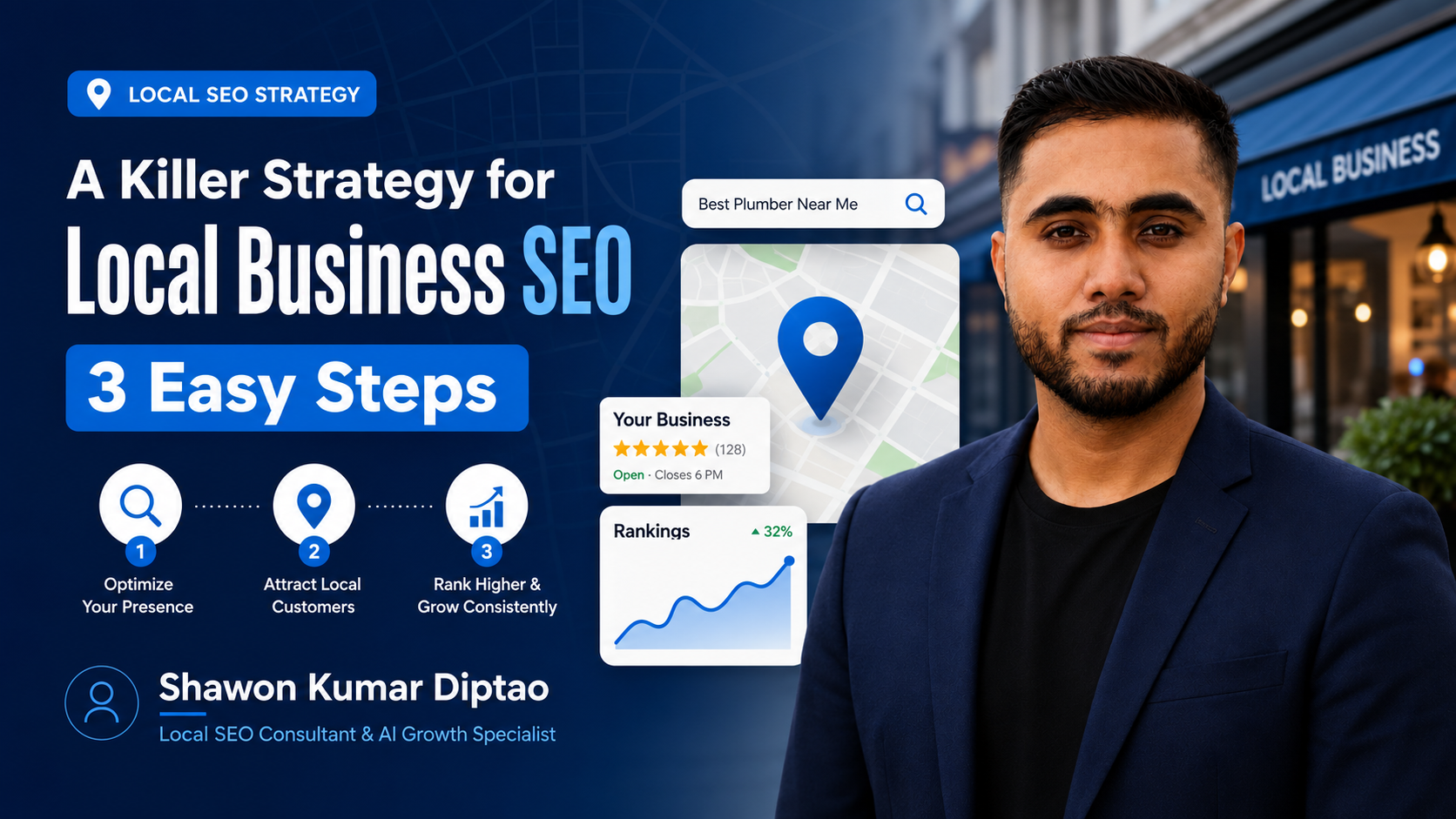
What Is a Killer Strategy for Local Business SEO? 3 Easy Steps to Rank on Google and AI Overviews
A killer strategy for local business SEO involves three essential steps: build a strong local search foundation, create content that answers high-intent customer questions, and increase authority through reviews, citations, and relevant backlinks. Together, these steps help Google understand what your business offers, which customers you serve, and why your company deserves greater visibility.
Local search has changed significantly. Customers no longer search using only short phrases such as “SEO company” or “marketing services.” They now ask detailed questions, compare providers, research costs, read reviews, and look for immediate solutions.
At the same time, businesses are competing for visibility across traditional organic results, Google Maps, the local pack, featured snippets, and Google AI Overviews.
That means adding a few geographic keywords to your website is no longer enough. To increase local visibility, your business must demonstrate relevance, authority, experience, and trust at every stage of the customer journey.
This guide explains a killer strategy for local business SEO in 3 easy steps and shows how you can use it to attract more qualified local customers.
Why Is Local Business SEO Important?
Local business SEO is the process of improving a company’s visibility for searches connected to a particular service area. Its purpose is to help nearby or service-area customers discover the business when they need its products or services.
An effective local SEO strategy can help a company appear in:
- Google’s organic search results
- Google Maps
- The local three-pack
- “Near me” searches
- Featured snippets
- Voice-search answers
- Google AI Overviews
- Service-specific local searches
This visibility matters because many local searches have strong commercial intent. Someone searching for the cost of a service, the best provider nearby, or a solution to an urgent problem may already be close to making a decision.
However, rankings alone are not the final goal. Your local SEO campaign should generate meaningful business results, including phone calls, bookings, quote requests, store visits, and qualified leads.
How Has Local Search Changed?
Google evaluates many signals when deciding which local businesses to display. These signals include the relevance of the business to the search, the customer’s proximity to the service area, and the business’s overall prominence.
Prominence may be influenced by factors such as:
- Customer reviews
- Business listings
- Website quality
- Local citations
- Relevant backlinks
- Brand mentions
- Content expertise
- Business information consistency
- User engagement
Search behavior has also become more conversational. Instead of entering one or two keywords, customers may ask questions such as:
- Why is my business not ranking on Google Maps?
- How much does local SEO cost for a small business?
- How long does local SEO take to work?
- What is the best way to improve local Google rankings?
- Can a small business appear in Google AI Overviews?
Content that directly and accurately answers these questions is more useful to customers and easier for answer engines to understand.
Step 1: Build a Strong Local Search Foundation
The first step in a successful local SEO strategy is to ensure that Google and potential customers can clearly understand your business.
Your business name, services, contact information, opening hours, website, and service area should be accurate and consistent across the internet.
Optimize Your Google Business Profile
A complete Google Business Profile is one of the most important components of local search visibility.
Review and optimize the following elements:
- Business name
- Primary business category
- Relevant secondary categories
- Telephone number
- Website address
- Business hours
- Service areas
- Products or services
- Business description
- Photos and videos
- Appointment or booking links
Choose categories that accurately describe your primary services. Adding unrelated categories may confuse customers and weaken the relevance of your profile.
Your business description should clearly explain what you provide, who you serve, and what makes your company different. Avoid unnatural keyword repetition. Use your primary services and local SEO keywords only where they make sense.
You should also keep your profile active by publishing:
- Service updates
- New project information
- Seasonal announcements
- Special operating hours
- Frequently asked questions
- Original business photos
- Educational posts
Regular activity does not replace a complete optimization strategy, but it helps keep your profile useful and current.
Keep Your Business Information Consistent
Google may compare your business details across your website, social profiles, directories, associations, and other online platforms.
Your name, address, and telephone number are commonly referred to as NAP information. These details should be consistent wherever your company appears.
Common consistency problems include:
- Old telephone numbers
- Incorrect addresses
- Different versions of the business name
- Outdated opening hours
- Duplicate business profiles
- Broken website links
- Incorrect service areas
- Listings created by former employees
These issues frequently appear after a company moves, rebrands, changes its telephone number, or launches a new website.
Conduct a citation audit whenever your business information changes. Correcting inaccurate listings can help search engines and customers identify the correct business details.
Strengthen Your Website’s Local Signals
Your website should clearly communicate what services you offer and which customers you serve.
Each main service should have a dedicated page that includes:
- A clear service description
- The problems the service solves
- Customer benefits
- Your process
- Pricing factors
- Relevant FAQs
- Testimonials or examples
- A clear call to action
Avoid creating dozens of thin location pages that contain nearly identical content. A useful geographic landing page should provide original information about the service experience in that area.
When appropriate, your website should also include:
- A detailed contact page
- A professional About page
- Author information
- Customer testimonials
- Service-area information
- LocalBusiness or ProfessionalService schema
- Article schema
- FAQ schema
- Breadcrumb navigation
These elements can help search engines understand your business structure and improve customer confidence.
Step 2: Create Content for High-Intent Local Questions
The second step is to produce content around the real questions customers ask before choosing a service provider.
Broad keywords can generate impressions, but long-tail questions often reveal clearer intent.
For example, the keyword “local SEO” is broad. The question “Why is my local business not ranking on Google Maps?” identifies a specific problem and may attract a potential customer who needs professional assistance.
Research Long-Tail Local Keywords
A strong local keyword strategy should cover multiple stages of the customer journey.
Useful keyword patterns include:
- Service plus cost
- Service plus near me
- Service plus problem
- Service plus comparison
- Service plus timeline
- Service plus review
- Service plus service area
- Best service provider
- Emergency service
- How to choose a provider
For an SEO or marketing business, relevant long-tail keywords may include:
- Local SEO services for small businesses
- How to rank a local business on Google
- Google Business Profile optimization
- Why local rankings suddenly dropped
- Local SEO consultant versus marketing agency
- How much professional local SEO costs
- How to rank in Google AI Overviews
- Local keyword research services
- Local citation audit
- AEO content optimization
The purpose is not to place every keyword into one article. Instead, organize related terms into topic clusters and assign each topic to the most appropriate page.
Match Content to Search Intent
Local customers usually search with one of four main intentions.
Informational Intent
The customer wants to learn something.
Examples include:
- How does local SEO work?
- What affects local rankings?
- How do Google reviews influence visibility?
Commercial Intent
The customer is comparing possible solutions.
Examples include:
- Best local SEO company for a small business
- SEO consultant versus digital marketing agency
- What should I look for in an SEO professional?
Transactional Intent
The customer is ready to take action.
Examples include:
- Hire a local SEO expert
- Request an SEO audit
- Get help with Google Business Profile optimization
Troubleshooting Intent
The customer has an immediate problem.
Examples include:
- Why is my business missing from Google Maps?
- Why did my website traffic suddenly decline?
- Why is the wrong business information appearing online?
A complete content strategy should support all four types of intent. Educational content builds awareness, while commercial and transactional pages turn that awareness into inquiries.
Make Your Content AEO-Ready
Answer engine optimization, or AEO, helps search engines and AI systems extract clear answers from your pages.
A well-structured AEO section usually includes:
- A question-based heading
- A direct answer
- A detailed explanation
- An example, checklist, or warning
- A relevant internal link
For example:
Why Is My Business Not Appearing on Google Maps?
Your business may not appear because its Google Business Profile is incomplete, its categories do not match the search, or its online information is inconsistent. Limited reviews, duplicate listings, low website authority, profile suspension, and strong competition can also reduce visibility.
The direct answer gives readers immediate value. The supporting paragraphs can then explain how to diagnose and fix each issue.
Connect Blog Posts to Your Main Service Pages
Blog content should support your main commercial pages through internal links.
A guide about local ranking problems can link to a local SEO audit service. An article about Google listings can support a Google Business Profile optimization page. A cost guide can direct readers to your consultation or service page.
Use descriptive anchor text such as:
- Local SEO strategy
- Professional SEO consultant
- Google Business Profile optimization
- Small business SEO services
- Local keyword research
- AEO content optimization
- Improve local Google rankings
Avoid repeatedly using vague anchor text such as “click here” or “learn more.”
Businesses looking for professional support can explore the SEO and marketing services offered by Shawon Kumar Diptao.
Step 3: Build Local Authority and Customer Trust
The third step is to establish credible external signals that confirm your business is legitimate, experienced, and trusted.
These signals include customer reviews, accurate citations, relevant backlinks, business mentions, testimonials, and expert content.
Create a Sustainable Review Strategy
Reviews influence both customer decisions and local business credibility.
Ask satisfied customers for honest feedback after an appropriate moment, such as:
- A completed project
- A successful appointment
- A resolved support issue
- A delivered product
- A positive customer conversation
Make the process easy by providing a direct review link. Respond professionally to positive and negative reviews.
Avoid:
- Purchasing fake reviews
- Offering rewards only for positive feedback
- Asking employees to pose as customers
- Publishing reviews from fabricated accounts
- Pressuring customers to include exact keywords
A natural review profile should develop gradually and reflect genuine customer experiences.
Build Accurate Local Citations
A local citation is an online mention of your business details.
Citations can appear on:
- Major business directories
- Industry-specific platforms
- Professional associations
- Local organizations
- Supplier websites
- Partner directories
- Community websites
Focus on quality, accuracy, and relevance rather than creating the largest possible number of listings.
A trusted industry directory or business association may provide more value than dozens of low-quality websites.
Earn Relevant Backlinks
Backlinks from credible websites can strengthen the authority of your domain and service pages.
Potential link-building opportunities include:
- Professional associations
- Community partnerships
- Industry interviews
- Supplier relationships
- Local publications
- Expert contributions
- Original research
- Educational resources
- Event sponsorships
- Business collaborations
Avoid services that promise hundreds of backlinks within a few days. These links are often irrelevant, automated, or placed on low-quality websites.
The best links usually come from genuine relationships, useful resources, original insights, and reputable organizations.
Demonstrate EEAT
EEAT refers to experience, expertise, authoritativeness, and trustworthiness.
Your website can strengthen these signals by including:
- A clear author biography
- Professional experience
- Original examples
- Client-approved case studies
- Accurate service information
- Transparent contact details
- Updated publication dates
- Reliable references
- A clear working process
- Genuine customer feedback
Content published under the name Shawon Kumar Diptao should include an author profile explaining relevant SEO and marketing knowledge, practical experience, and areas of expertise.
Original screenshots and measured outcomes can also strengthen credibility. However, never invent statistics or claim results you cannot verify.
Use information from Google Search Console, Google Business Profile Performance, analytics tools, call tracking, customer surveys, and sales records.
Useful original metrics may include:
- Growth in local search impressions
- Increase in qualified inquiries
- Calls generated through a Google profile
- Highest-converting service pages
- Most frequently searched customer questions
- Conversion rates by landing page
How Much Does Local Business SEO Cost?
The cost of local SEO depends on the business’s goals, competition, website condition, number of services, and geographic reach.
Important cost factors include:
- Number of service pages
- Number of service areas
- Website size
- Technical SEO problems
- Content requirements
- Citation inconsistencies
- Review profile
- Backlink competition
- Analytics and reporting needs
- Current search visibility
A business with a technically healthy website may primarily need content, reviews, and authority building. Another company may require a full website restructure, technical repairs, citation cleanup, tracking setup, and new service pages.
DIY Local SEO vs. Professional SEO
Managing SEO internally may reduce direct service expenses, but it still requires time, tools, research, and consistent implementation.
A professional may be valuable when:
- The market is highly competitive
- Rankings have declined
- The website has technical problems
- Business information is inconsistent
- The company is entering new service areas
- Internal staff lack SEO experience
- Marketing activity is not producing leads
Measure the value of SEO through business outcomes rather than keyword positions alone.
Important performance indicators include:
- Qualified phone calls
- Form submissions
- Consultation requests
- Bookings
- Sales
- Conversion rate
- Customer acquisition cost
- Revenue from organic search
A number-one ranking has little value when it attracts the wrong audience or produces no inquiries.
How Can You Build GEO Relevance Without Keyword Stuffing?
Geographic optimization should reflect the areas your business genuinely serves.
You do not need to mention a city in every heading or paragraph. Search engines can understand location through business details, structured data, customer reviews, service-area content, citations, and other signals.
Create a dedicated area page only when you can provide unique and helpful information.
A valuable service-area page might include:
- Services available in that area
- Common customer problems
- Relevant examples
- Distinct FAQs
- Service availability
- Testimonials from nearby clients
- Travel or scheduling considerations
- A clear local call to action
Avoid creating hundreds of pages that simply replace one city name with another. These pages provide little value and may appear manipulative.
Local SEO Maintenance and Prevention Checklist
Local SEO is not a one-time activity. Business information, competitors, customer behavior, and search results continuously change.
Monthly Local SEO Tasks
- Review your Google Business Profile
- Confirm opening hours
- Respond to customer reviews
- Add new photos or updates
- Check Search Console queries
- Test contact forms
- Test telephone links
- Review important keyword rankings
- Add relevant internal links
- Check for broken pages
Quarterly Local SEO Tasks
- Audit business citations
- Review competitors
- Refresh important service pages
- Update outdated statistics
- Improve underperforming content
- Check technical SEO issues
- Review schema markup
- Test conversion tracking
- Consolidate overlapping content
- Update service-area information
Regular maintenance can prevent problems such as incorrect opening hours, duplicate listings, ranking losses, broken contact forms, outdated content, and keyword cannibalization.
When Should You Call a Local SEO Professional?
You should consider professional SEO assistance when your business is not appearing in local results, rankings have suddenly declined, or your website receives traffic without generating leads.
Professional assistance may also be necessary when:
- Your Google Business Profile is suspended
- Duplicate listings exist
- Competitors dominate Google Maps
- Your website is not being indexed
- Business information is inconsistent
- You are launching a new service
- You are expanding into new areas
- You lack time to manage SEO consistently
- Previous SEO work produced poor results
A reliable professional should explain the strategy clearly, set realistic expectations, and connect SEO work to measurable business objectives.
Why Choose Shawon Kumar Diptao for SEO and Marketing?
Shawon Kumar Diptao provides SEO and marketing guidance focused on search intent, content quality, technical performance, and sustainable visibility.
The approach can include:
- Local keyword research
- SEO content planning
- AEO-ready page structures
- Google Business Profile recommendations
- On-page optimization
- Internal linking
- Technical SEO guidance
- Service-page support
- Competitor research
- Performance measurement
The objective is not simply to increase impressions. It is to connect businesses with relevant customers who are ready to call, book, purchase, or request more information.
Start Building a Stronger Local Search Presence
A killer local SEO strategy does not depend on one secret trick.
It combines accurate business information, helpful content, long-tail keyword targeting, clear answers, genuine customer reviews, relevant citations, authoritative links, and consistent maintenance.
Begin with the foundation. Make sure search engines can understand your business and verify its information.
Next, publish content that answers the questions customers ask before making a decision.
Finally, build the external trust signals that demonstrate your experience, reputation, and authority.
For a strategy tailored to your business goals, visit Shawon Kumar Diptao’s SEO and marketing website.
Frequently Asked Questions
What Is a Killer Strategy for Local Business SEO?
A killer local SEO strategy has three parts: optimize your business information, publish content for high-intent local questions, and build authority through reviews, citations, links, and expert content. The three elements should work together rather than being treated as separate campaigns.
How Long Does Local SEO Take to Work?
Initial improvements may appear within several weeks, but meaningful results often require several months of consistent work. The timeline depends on competition, website quality, technical problems, business history, content, reviews, and existing authority.
Can a Small Business Rank in Google AI Overviews?
A small business can improve its eligibility by publishing clear, accurate, and well-structured answers supported by genuine expertise. Strong authorship, trustworthy business information, useful examples, and relevant supporting content may also help, although inclusion is never guaranteed.
Why Is My Business Not Ranking on Google Maps?
Common causes include an incomplete Google Business Profile, incorrect categories, inconsistent citations, weak website relevance, limited reviews, duplicate listings, profile problems, or stronger local competitors. A complete audit is usually needed to identify the exact cause.
Is Local SEO Worth Paying For?
Local SEO can be worthwhile when customers use search engines before calling, visiting, booking, or buying. Its value should be measured through qualified leads, sales, conversion rates, and customer acquisition costs—not rankings alone.