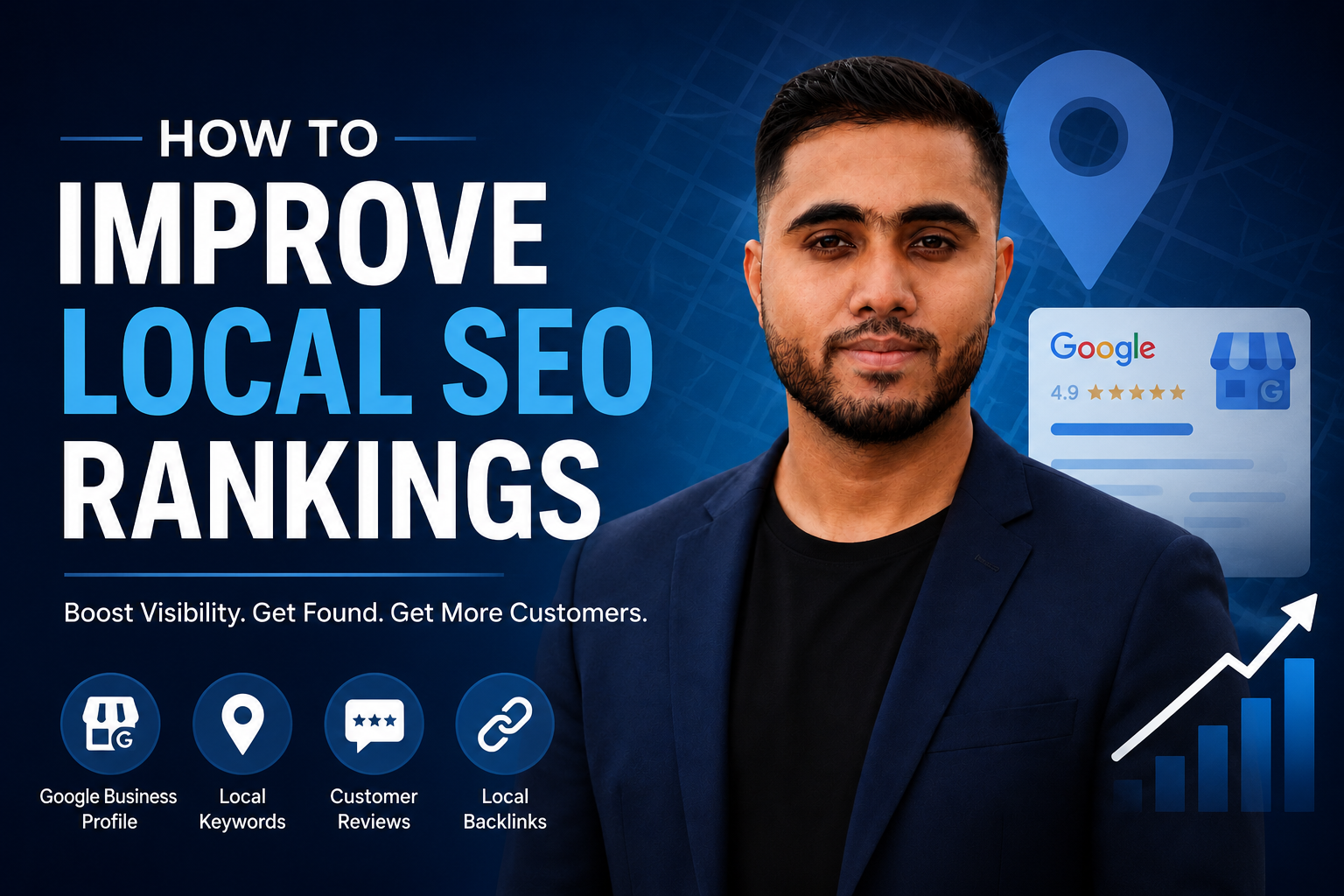
Why Is My Business Not Ranking Locally? How to Improve Local SEO Rankings
Your business may not be ranking locally because Google does not have enough accurate, relevant, and trustworthy information to connect your company with nearby searches. Common causes include an incomplete Google Business Profile, inconsistent contact information, weak service pages, limited customer reviews, poor local authority, and technical website problems.
Learning how to improve local SEO rankings requires more than adding location keywords to your website. You need to strengthen every signal that helps search engines understand what your business offers, where it operates, and why local customers should choose it.
This guide explains why your company may be missing from local results and what you can do to improve visibility in Google Search, Google Maps, local packs, voice search, and AI-generated answers.
How Can You Improve Local SEO Rankings?
To improve your local SEO rankings, you should:
- Complete and optimize your Google Business Profile.
- Use accurate business categories.
- Keep your name, address, and phone number consistent.
- Create detailed service and service-area pages.
- Earn genuine customer reviews.
- Build relevant local citations and backlinks.
- Improve mobile usability and website speed.
- Add structured data.
- Track calls, enquiries, bookings, and sales.
These actions help search engines understand your business while giving prospective customers more reasons to trust you.
How Google Evaluates Local Businesses
Google considers several signals when deciding which businesses should appear for location-based searches. The three main concepts are relevance, distance, and prominence.
Relevance
Relevance measures how closely your business matches the searcher’s request.
For example, someone searching for “emergency plumbing near me” expects to find a plumber who clearly offers emergency repairs. A business with only a general plumbing page may be less relevant than a competitor with a detailed emergency plumbing service page, an accurate business category, and reviews that mention urgent repair work.
Your website, services, Google Business Profile, content, and reviews should clearly explain what you do.
Distance
Distance refers to how close your business is to the person searching or the location included in the search.
A company may rank strongly near its verified location but appear less often in surrounding communities. That does not mean you should create fake addresses or stuff dozens of place names into your pages.
Instead, build genuine relevance for the areas you serve through helpful service-area content, local customer examples, accurate coverage information, and strong internal linking.
Prominence
Prominence reflects how established and trusted your business appears.
Search engines may evaluate:
- Customer reviews
- Local citations
- Relevant backlinks
- Website authority
- Brand mentions
- Business history
- Content quality
- Online reputation
A company with complete information, strong reviews, useful content, and credible local links will often have a better chance of ranking than a competitor with a weak online presence.
Why Is My Business Not Ranking Locally?
Local visibility problems usually result from several smaller issues rather than one single mistake.
Your Google Business Profile Is Incomplete
Your Google Business Profile is one of the most important assets for local search visibility.
Missing services, hours, categories, photos, contact details, or service areas can make it difficult for Google and potential customers to understand your business.
Check that your profile includes:
- Your real business name
- The most accurate primary category
- Relevant secondary categories
- Current opening hours
- A working phone number
- Your correct website address
- Complete service information
- Your genuine address or service area
- High-quality business photos
- A clear company description
Do not add unnecessary keywords to your official business name. Your profile should reflect how your business is represented in the real world.
You Chose the Wrong Business Categories
Your primary category tells Google what type of business you operate.
A broad or inaccurate category may reduce your relevance for high-value searches. Choose the category that best represents your main service, then add only the secondary categories that accurately describe additional services.
For example, a company focused primarily on roof replacement should not rely only on a broad contractor category when a more accurate roofing-related category is available.
Your Business Information Is Inconsistent
Your business name, address, and phone number are commonly referred to as NAP information.
These details should be consistent across:
- Your website
- Google Business Profile
- Social media profiles
- Industry directories
- Local business listings
- Professional associations
- Map platforms
Minor differences in formatting are not always harmful. However, outdated addresses, disconnected telephone numbers, duplicate listings, and conflicting business names can damage trust and confuse customers.
Your Website Does Not Clearly Explain Where You Work
A business website may describe its services without clearly identifying its service area.
Your location relevance should appear naturally on your:
- Home page
- Service pages
- Contact page
- About page
- Service-area pages
- Page titles
- Main headings
- Internal links
You do not need to repeat every location in every paragraph. The goal is to make your service coverage clear without creating keyword-stuffed content.
Your Service Pages Are Too Thin
Generic service pages often fail to answer the questions customers ask before contacting a business.
A strong service page should explain:
- What the service includes
- Who needs the service
- Common problems it solves
- How the process works
- Factors that influence cost
- Why customers should trust the company
- Which areas are served
- What the customer should do next
Detailed service content improves topical relevance and gives you more opportunities to rank for long-tail searches.
You Have Too Few Recent Reviews
Customer reviews can influence trust, click-through rates, and local prominence.
A company with many old reviews but little recent activity may appear less active than a competitor that consistently receives current feedback.
Create a simple review process. Ask genuine customers for feedback after completing a service, delivering a product, or resolving a support request.
Never purchase reviews or ask customers to post misleading comments. Fake reviews can damage your reputation and create platform-related risks.
Your Competitors Have Stronger Local Authority
Your competitors may be outperforming you because they have:
- Better service pages
- More complete business profiles
- Stronger customer reviews
- More relevant backlinks
- Accurate directory listings
- Better website performance
- More useful local content
- Stronger brand recognition
A local SEO competitor analysis can show which signals are helping competing businesses rank and where your strategy needs improvement.
Your Website Has Technical SEO Problems
Even excellent content may struggle when a website has technical issues.
Common problems include:
- Slow loading times
- Poor mobile usability
- Broken internal links
- Missing pages
- Incorrect redirects
- Duplicate content
- Accidental noindex tags
- Weak website architecture
- Crawling and indexing problems
- Intrusive pop-ups
A technically healthy website makes it easier for search engines to access your content and for customers to contact your business.
How to Improve Local SEO Rankings Step by Step
1. Optimize Your Google Business Profile
Start by reviewing every section of your profile.
Make sure your services, categories, hours, contact information, photos, and business description are accurate. Add special hours for holidays and update your information whenever something changes.
Upload real photos of your team, location, equipment, completed work, or products. Original images can build trust more effectively than generic stock photography.
2. Conduct Local Keyword Research
Local keyword research helps you understand how nearby customers search for your services.
Include different types of searches, such as:
- Service plus location
- Service near me
- Best service provider nearby
- Emergency service searches
- Cost-related searches
- Comparison searches
- Problem-based searches
- Question-based searches
- Service-area searches
Someone searching “how much does local SEO cost?” is still researching. A person searching “hire a local SEO consultant” has stronger commercial intent.
Your website should contain content for both stages of the customer journey.
3. Build Better Service Pages
Create a dedicated page for each important service rather than listing everything on one short page.
Every service page should have a clear primary topic and naturally include related terms.
For a local SEO service page, related keywords may include:
- Local SEO services
- Google Maps optimization
- Google Business Profile optimization
- Local search marketing
- Local keyword research
- Citation management
- Review management
- Local link building
- Service-area SEO
- Local SEO audits
Avoid forcing the same keyword into every heading. Use natural language that answers customer questions.
4. Improve Your Internal Linking
Internal links help search engines understand the structure and importance of your pages.
A supporting blog post about improving local rankings should link to your main local SEO service page using descriptive anchor text.
For example, businesses looking for a complete strategy can explore the professional SEO services offered by Shawon Kumar Diptao.
Other useful internal-link anchors may include:
- Local SEO services
- Improve your Google visibility
- Google Business Profile optimization
- Professional SEO consultant
- SEO services for small businesses
- Local search marketing strategy
- Rank higher in Google Maps
- AEO and AI search optimization
Internal links should be helpful and contextually relevant. Avoid using the same exact anchor text excessively.
5. Correct Local Citations
Local citations are online references to your business information.
Focus on respected platforms that are relevant to your country, industry, and customer base. Correct inaccurate information before creating new listings.
Quality matters more than quantity. Hundreds of low-quality directory links are unlikely to provide the same value as a smaller number of accurate, credible listings.
6. Create a Review Management System
Review generation should be an ongoing business process.
You can request reviews through:
- Follow-up emails
- Text messages
- Printed receipts
- Appointment reminders
- Customer service conversations
- Post-project follow-ups
Make the process simple by sending customers directly to the appropriate review page.
Respond to positive reviews with genuine appreciation. Address negative feedback professionally and avoid sharing confidential customer information.
7. Earn Relevant Local Backlinks
Backlinks from credible websites can strengthen authority.
Potential opportunities include:
- Local business associations
- Chambers of commerce
- Community organizations
- Industry partners
- Suppliers
- Local publications
- Charitable organizations
- Event sponsorships
- Professional directories
- Educational resources
The strongest links are usually earned through real business relationships, useful content, or meaningful community involvement.
8. Improve Mobile Experience and Website Speed
Many local searches happen on mobile devices. Customers may be looking for a phone number, directions, availability, or immediate help.
Your website should:
- Load quickly
- Use readable text
- Have clear navigation
- Display buttons correctly
- Make phone numbers clickable
- Use simple contact forms
- Avoid intrusive overlays
- Present important information immediately
A slow or confusing mobile experience can cause potential customers to leave before contacting you.
9. Add LocalBusiness Schema Markup
Structured data helps search engines interpret important business information.
LocalBusiness schema may include:
- Business name
- Address
- Telephone number
- Website
- Opening hours
- Business type
- Geographic coordinates
- Social profiles
Schema should match the visible information on your website. It does not guarantee a higher ranking, but it can make your business details easier for search engines to understand.
How to Rank in Nearby Service Areas
Many companies want to rank beyond their immediate location.
You can support visibility in nearby areas by creating genuinely useful service-area pages. Each page should provide information that matters to customers in that location.
A strong area page may include:
- Services available in the area
- Common local customer needs
- Relevant property or industry conditions
- Your service process
- Travel or scheduling information
- Customer examples
- Frequently asked questions
- Links to relevant service pages
- A clear contact option
Avoid creating dozens of pages that are identical except for the place name. These pages provide little value and may weaken your website’s overall quality.
Only target areas you genuinely serve.
How Much Does It Cost to Improve Local SEO Rankings?
The cost of local SEO depends on the size of your business, competition, website condition, number of locations, and the amount of work required.
Common pricing factors include:
- Google Business Profile optimization
- Keyword research
- Competitor analysis
- Website audits
- Technical SEO
- Service-page creation
- Service-area content
- Citation cleanup
- Review strategy
- Link building
- Reporting and conversion tracking
A single-location business with a strong website may need a smaller campaign. A multi-location business with duplicate listings, weak content, and technical problems will usually require a broader strategy.
Be cautious of extremely cheap packages that promise hundreds of links or guaranteed first-place rankings. Sustainable local SEO requires research, implementation, monitoring, and continued improvement.
A Practical Local SEO Scenario
Consider a local service business with an incomplete Google Business Profile, inconsistent directory information, one generic services page, and only a few customer reviews.
Its leading competitor has dedicated service pages, an accurate profile, recent reviews, locally relevant backlinks, and helpful content answering common customer questions.
The first business should not respond by stuffing more location keywords into its homepage.
A better approach would be to:
- Correct its profile and citations.
- Create detailed service pages.
- Fix technical problems.
- establish a review process.
- Develop useful local content.
- Earn relevant local links.
- Track enquiries and conversions.
These improvements create stronger relevance, authority, and trust.
Local SEO Mistakes to Avoid
Certain tactics may create short-term changes but lead to long-term problems.
Avoid:
- Adding keywords to your official business name
- Creating fake office locations
- Buying customer reviews
- Publishing duplicate area pages
- Copying competitors’ content
- Purchasing irrelevant backlinks
- Ignoring negative feedback
- Using outdated business information
- Targeting locations you do not serve
- Measuring rankings without tracking leads
No SEO provider can guarantee a permanent first-place ranking. Results vary based on competition, location, search intent, proximity, authority, and the person conducting the search.
How to Maintain Your Local SEO Rankings
Local SEO is not a one-time project.
Maintain your visibility by:
- Reviewing profile information monthly
- Updating holiday and seasonal hours
- Requesting customer reviews consistently
- Publishing useful local content
- Updating older service pages
- Monitoring competitors
- Fixing technical problems
- Checking directory information
- Building relevant relationships and links
- Tracking calls, enquiries, and revenue
These ongoing activities help protect your local visibility as competitors, customer behaviour, and search results change.
When to Call a Local SEO Professional
Professional help may be appropriate when:
- Your rankings continue to decline.
- Your Google Business Profile has been suspended.
- Your business does not appear for core services.
- Competitors dominate the local pack.
- You serve several locations.
- Your website has technical problems.
- You receive traffic but very few leads.
- You cannot determine which marketing activities generate results.
- You lack the time or expertise to manage local SEO consistently.
An experienced professional can identify whether your main issue involves relevance, proximity, authority, content, citations, reviews, technical SEO, or conversion performance.
Why Choose Shawon Kumar Diptao for Local SEO?
Shawon Kumar Diptao helps businesses build SEO strategies focused on visibility, relevance, customer intent, and lead generation.
The approach may include:
- Local SEO audits
- Google Business Profile optimization
- Local keyword research
- Competitor analysis
- Service-page planning
- Content strategy
- Internal-link optimization
- Technical SEO
- AEO-focused content
- AI Overview optimization
- Local authority building
- Conversion tracking
The goal is not simply to increase rankings. It is to help your business attract more relevant visitors, calls, enquiries, appointments, and customers.
Local SEO Improvement Checklist
Use this checklist to evaluate your current local presence:
- Is your Google Business Profile verified?
- Is your primary category accurate?
- Are your services fully listed?
- Are your opening hours current?
- Is your contact information consistent?
- Does every major service have a dedicated page?
- Does your website explain where you operate?
- Do you receive genuine reviews regularly?
- Are important citations accurate?
- Does your website work well on mobile devices?
- Are your pages loading quickly?
- Have you added appropriate schema markup?
- Are you earning credible local links?
- Are calls and enquiries being tracked?
- Are older pages updated regularly?
Frequently Asked Questions
Q. Why is my business not appearing in local Google searches?
Your business may have an incomplete profile, weak location relevance, inconsistent contact information, limited reviews, poor service content, or stronger local competitors. Distance from the searcher can also affect visibility.
Q. How long does it take to improve local SEO rankings?
The timeline depends on your market, website condition, competition, profile history, and existing authority. Some corrections can influence visibility relatively quickly, while competitive local campaigns usually require consistent long-term work.
Q. Can a service-area business rank without displaying an address?
A legitimate service-area business may be able to maintain a Google Business Profile without publicly displaying its address. It must still meet eligibility requirements and provide accurate service-area information.
Q. Do customer reviews help improve local rankings?
Reviews can strengthen trust and contribute to local prominence. Recent, genuine reviews may also improve click-through rates by showing potential customers that your business is active and credible.
Q. Should I create a separate page for every nearby area?
Create a page only when you can provide unique and useful information for customers in that area. Avoid duplicate pages that simply replace one location name with another.
Improve Your Local Visibility with Shawon Kumar Diptao
Improving local rankings requires more than adding keywords to your website. Your business needs accurate information, useful service content, genuine customer reviews, technical reliability, credible local authority, and a clear measurement strategy.
Shawon Kumar Diptao helps businesses improve their presence across Google Search, Google Maps, local results, AI-generated answers, and other discovery platforms.
Visit Shawon Kumar Diptao to explore professional SEO strategies designed to increase visibility, attract qualified customers, and support sustainable business growth.