How AI Can Help With Local SEO: 4 Ways to Create Answer-Focused Content for Google AI Overviews
AI can help local businesses improve visibility when it is used to uncover real customer questions, organize useful content, strengthen service pages, and maintain accurate business information. The winning approach is not to let AI publish everything alone. Use it as a research and workflow tool, then add expert review, verified details, and a clear next step for prospects.
For local SEO, people usually search with a problem in mind. They want to know the cost, the process, the right provider, or the fastest solution. Answer-focused content helps your website respond directly. That supports long-tail rankings, local lead generation, and visibility in AI-powered search experiences such as Google AI Overviews.
What Does AI Do for Local SEO?
AI is valuable when it turns scattered information into a practical content plan. It can group keyword themes, summarize recurring questions, identify gaps, and speed up first drafts. It cannot replace business experience, local knowledge, or fact-checking.
Start with real inputs: sales calls, emails, form submissions, Google Business Profile reviews, Search Console queries, and questions your team hears regularly. Then use AI to organize the findings into clear content topics. Questions about pricing can support a cost guide. Questions about timelines can support a process section. Questions about visibility can support a local SEO service page.
1. Use AI to Find the Questions Local Customers Actually Ask
The first way AI can help with local SEO is by revealing question-based opportunities that broad keyword research may miss. A general term has value, but the question behind it often signals stronger intent.
Collect real questions, then group them into categories:
- Cost and budget
- Comparisons and alternatives
- Urgent problems
- Process and timelines
- Trust, results, and proof
- Maintenance and prevention
For an SEO and marketing business, useful questions may include: “Why is my Google Business Profile not generating calls?”, “Do I need local SEO or paid ads?”, and “Why does my website rank but not produce leads?” These topics match the moments when prospects are looking for an expert.
Write the Answer Before the Explanation
Place a direct answer immediately under each question-based heading. Use two to four sentences, then expand with examples, steps, warnings, and a CTA.
For example, answer “Can AI improve local rankings?” by saying that AI supports research, content structure, and updates, while rankings still depend on helpful pages, technical health, local relevance, trust signals, and customer experience.
This AEO-friendly format makes pages easier to scan, more useful on mobile, and clearer for search systems.
2. Turn Service Pages Into Answer-Focused Local Landing Pages
Many local service pages describe a service but do not explain why it matters, what problem it solves, or what happens next. AI can help you review pages for missing questions and unclear sections.
Every important service page should answer:
- What is the service?
- Who is it for?
- What problem does it solve?
- What is the process?
- What should the customer do next?
Add a short answer block near the top, followed by a problem-solution section, a simple process, FAQs, proof, and a direct contact path. This turns a basic service description into a page that can support rankings and conversions.
Add Local Context Without Keyword Stuffing
Local relevance does not come from repeating a city name. It comes from showing that you understand genuine business conditions: competition, seasonal demand, service coverage, buying behavior, and common customer concerns.
A business may struggle with generic service pages, incomplete Google Business Profile details, inconsistent contact information, or content that does not answer buyer questions. These are useful local SEO problems to address without forcing location terms into every sentence.
GEO-focused content is not about producing dozens of nearly identical area pages. It is about creating pages with distinct value, accurate information, and a real reason to exist.
3. Use AI to Strengthen Google Business Profile and Entity Signals
Customers evaluate your business through more than your website. They see your Google Business Profile, reviews, phone number, hours, service descriptions, social profiles, and citations. AI can help compare this information and create a practical review checklist.
Verify your business name, phone number, website, hours, primary category, services, photos, reviews, and contact details. These should be accurate and consistent wherever customers find your business.
Turn Reviews Into Better FAQs
Reviews reveal what customers care about: communication, results, pricing, speed, convenience, and trust. AI can group recurring themes, but the final content must be honest and based on real feedback.
If prospects often ask about reporting, timelines, or expected outcomes, answer those questions clearly on the relevant service page. If verified reviews point to a recurring benefit, use that insight to improve your proof, FAQ, or case-example sections.
4. Use AI to Refresh Content With Verified Performance Data
Local SEO requires ongoing maintenance. Search behavior changes, competitors improve their pages, services evolve, and customers ask new questions. AI can speed up the review process by summarizing performance data and prioritizing the pages that need work.
Review your most important pages at least quarterly. Look for high impressions with low clicks, traffic with few inquiries, and questions that are not answered clearly enough. Use Google Search Console, website analytics, conversion tracking, and Google Business Profile insights to guide changes.
You may need a stronger title, a clearer opening answer, better internal links, a more useful FAQ, or a more visible CTA.
Use Verified Data, Not Empty Promises
Avoid invented statistics and guaranteed-ranking claims. A better approach is to use your own verified 90-day data, such as changes in qualified leads, non-branded clicks, or calls from a high-value page. Explain what changed, what you improved, and what you will monitor next. This builds trust and shows that SEO is measured, not guessed.
Common Problems AI Cannot Fix Alone
AI cannot repair a weak offer, poor customer service, fake reviews, inaccurate business details, or a technically broken website. It also cannot guarantee a Google AI Overview placement.
Watch for thin content, duplicate area pages, outdated service information, inconsistent contact details, unclear conversion paths, and generic AI copy with no original insight. Use AI for speed, but rely on expert review for accuracy, strategy, and quality.
What Does AI-Powered Local SEO Cost?
The cost depends on your starting point. A basic project may focus on content updates and Google Business Profile improvements. A broader campaign can include technical SEO, service-page rewrites, conversion tracking, internal linking, and ongoing reporting.
Before you invest, ask what is included, which pages are priorities, how results will be measured, and who will verify the content. A useful plan focuses on leads and business outcomes—not vanity traffic.
Prevention and Maintenance Tips
Use this simple maintenance checklist:
- Verify business information every month.
- Record new questions from calls, emails, and reviews.
- Update core service pages each quarter.
- Review internal links when publishing new content.
- Check mobile usability, indexing, and technical issues.
- Track qualified inquiries, not traffic alone.
These actions help your content stay accurate and aligned with customer needs.
When to Call a Local SEO Professional
Call a local SEO professional when your business gets visibility but not qualified leads, your service pages feel generic, your Google Business Profile is incomplete, or your team lacks time to review AI-assisted content properly.
Professional support is especially useful when you need technical SEO, content strategy, conversion improvement, internal linking, and local visibility to work together.
Why Choose Shawon Kumar Diptao for AI-Ready Local SEO?
Shawon Kumar Diptao helps businesses build practical SEO systems around AI-ready content, answer-focused pages, local visibility, technical improvements, and conversion opportunities. The focus is not on publishing more pages for the sake of it. It is on creating helpful content that answers customer questions and supports your main service pages.
Explore Shawon Kumar Diptao for a strategy designed to improve local search visibility and AI-powered discovery.
Final Thoughts
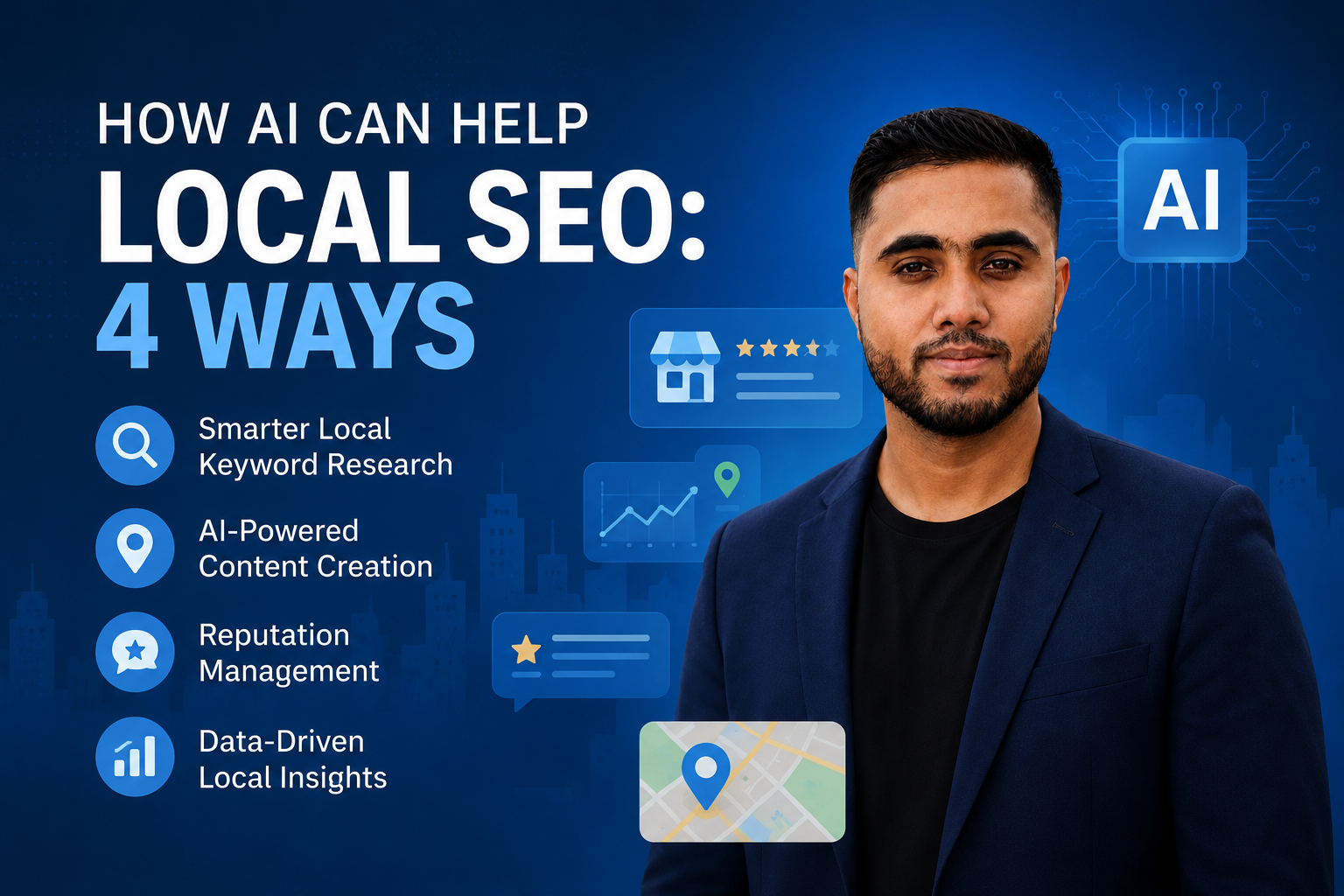
How AI can help with local SEO comes down to four actions: find real questions, improve service pages, strengthen business signals, and refresh content using verified data. Combined with expert review, AI can make your workflow faster without sacrificing quality.
Build pages that answer, prove, and convert. That is the foundation for stronger local rankings, better leads, and durable visibility across traditional and AI-powered search.
Frequently Asked Questions
Can AI help a local business rank on Google?
AI can support research, content planning, question clustering, page updates, and performance analysis. It does not replace accurate business information, helpful content, technical SEO, or a strong customer experience.
Can AI content appear in Google AI Overviews?
AI-assisted content can be useful when it is accurate, original, reviewed by a knowledgeable person, and designed to answer real questions. No provider can guarantee inclusion in Google AI Overviews.
What is answer-focused content for local SEO?
Answer-focused content gives a direct response to a customer question before adding deeper detail. It helps visitors understand the service, the problem it solves, and what to do next.
How often should local SEO content be updated?
Review high-value service pages and performance data at least once per quarter. Update earlier when services, customer questions, pricing, policies, or market conditions change.
Do I need a separate page for every service area?
No. Create an area page only when it provides distinct, accurate value. Avoid duplicate pages that simply replace one location name with another.