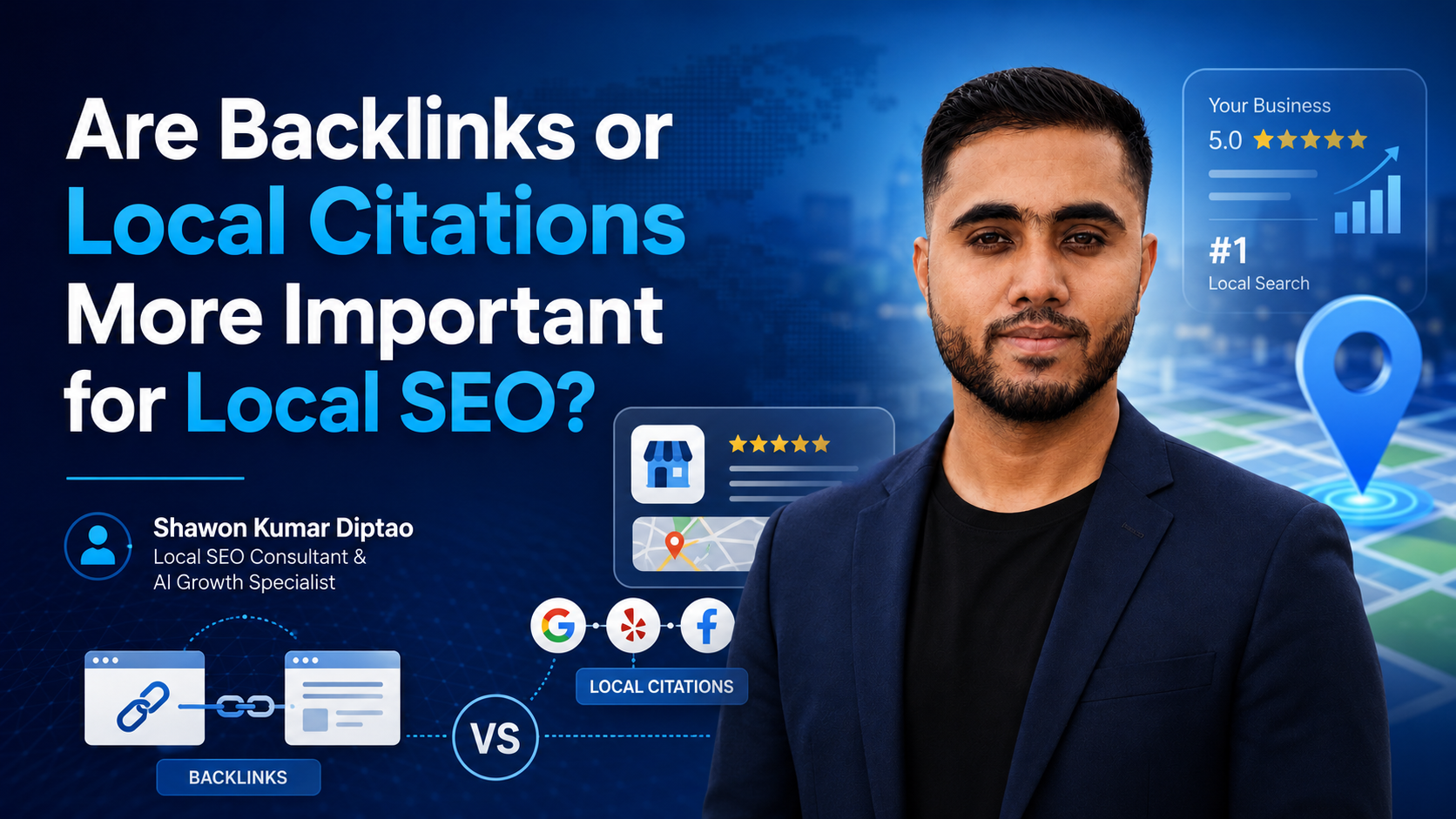
Are Backlinks or Local Citations More Important for Local SEO if Your Google Business Profile Is Not Ranking?
Local citations should usually be your first priority when your business information is missing, inaccurate, or inconsistent. However, once your core listings are correct, relevant local backlinks generally offer greater long-term value for improving authority, organic rankings, and Google Business Profile visibility.
In other words, citations build the foundation, while backlinks help strengthen your competitive position.
If your Google Business Profile is not ranking, however, simply creating more directory listings or purchasing backlinks may not solve the problem. Your profile could be affected by an incorrect category, weak website relevance, duplicate listings, limited reviews, proximity, verification problems, or a lack of local authority.
This guide explains how to decide whether backlinks or local citations deserve your attention first—and how to use both without wasting your marketing budget.
Are Backlinks or Local Citations More Important for Local SEO?
The practical answer is:
- Choose citation building first if your business has inconsistent names, addresses, phone numbers, hours, or website details online.
- Choose backlink building first if your core citations are already accurate but competitors have stronger websites and more local authority.
- Use both together if you operate in a competitive market and need to improve both Google Maps and traditional organic visibility.
Google explains that local search results are mainly determined by relevance, distance, and prominence. Prominence can be influenced by information Google finds across the web, including links, articles, directories, and reviews.
Neither backlinks nor citations should therefore be treated as a standalone ranking solution. They work best when your Google Business Profile, website, reviews, local content, and business information all support one another.
Why Is Your Google Business Profile Not Ranking?
Before choosing between backlinks and local citations, determine why your profile is underperforming.
Your primary category may be incorrect
Your primary Google Business Profile category should closely represent the main service your customers purchase.
For example, an SEO consultancy should select the most accurate available category rather than choosing a broad category simply because it appears to have higher search volume.
Secondary categories can help describe additional services, but adding unrelated categories may weaken the clarity of the profile.
Your business may be too far from the searcher
Distance is one of Google’s main local ranking considerations. A business may rank strongly near its verified location but become less visible when the search is performed several neighborhoods or service areas away.
Backlinks may improve prominence, but they cannot completely remove the influence of proximity.
This is why checking your ranking from only one phone or computer can produce a misleading result. Local rankings should be measured from several points across the area you serve.
Your website may not support the profile
Your Google Business Profile is connected to your website. If the linked page does not clearly explain your services, expertise, service areas, and customer value, Google may have difficulty understanding your relevance.
A strong local landing page should normally include:
- A clear primary service
- Supporting services
- Areas served
- Original business information
- Customer questions and answers
- Internal links to relevant pages
- Evidence of experience
- A clear contact action
Your business may lack prominence
An accurate profile is not automatically a prominent profile.
Nearby competitors may have more customer reviews, stronger websites, better-known brands, local press coverage, association memberships, community mentions, or authoritative backlinks.
This is where backlink building becomes especially valuable.
Your profile may have a technical or policy issue
A profile may also fail to rank properly because of:
- An unresolved verification issue
- A recent address change
- Duplicate profiles
- A misplaced map pin
- An ineligible virtual office
- Keyword stuffing in the business name
- Conflicting practitioner listings
- A suspension or restriction
- Major recent profile edits
Google requires businesses to use accurate addresses and legitimate service areas. Businesses should not use remote mailboxes or misleading locations to appear in areas where they do not actually operate.
If one of these issues exists, buying backlinks or citations is unlikely to be the right first step.
What Are Local Citations?
A local citation is an online mention of your business information.
It commonly includes your:
- Business name
- Address or service area
- Phone number
- Website address
- Opening hours
- Business category
Citations help customers and search platforms identify the business and confirm that its information is consistent across the web.
Structured citations
Structured citations appear in a standardized listing format.
Examples include:
- Business directories
- Map platforms
- Review websites
- Professional associations
- Chamber of commerce directories
- Industry-specific directories
- Social media business profiles
These listings normally contain clearly labeled fields for the business name, address, phone number, website, and operating hours.
Unstructured citations
An unstructured citation is a natural mention of a business on another webpage.
Examples include:
- A local news article
- An event sponsorship page
- A community resource
- A supplier’s website
- A neighborhood blog
- An interview
- An industry article
An unstructured mention may include the business name and website without presenting the information as a formal directory listing.
Why Does NAP Consistency Matter?
NAP stands for name, address, and phone number.
If your website shows one phone number, your Google Business Profile shows another, and several directories contain an old address, potential customers may not know which information is correct.
Incorrect listings can directly damage customer confidence. BrightLocal reports that 62% of consumers would avoid using a business after finding incorrect information online.
Citation consistency becomes especially important when a business:
- Moves to a new address
- Changes its telephone number
- Rebrands
- Changes its domain
- Adds a new location
- Closes an old location
- Changes its opening hours
- Switches from a storefront to a service-area model
The purpose of citation cleanup is not to make every mention on the internet identical down to punctuation. The goal is to ensure that the essential identifying information is current, accurate, and unlikely to confuse users.
What Are Local Backlinks?
A backlink is a clickable link from another website to your website.
Local backlinks come from websites that are geographically, professionally, or commercially relevant to your business.
Useful sources may include:
- Local news publications
- Chambers of commerce
- Business associations
- Community organizations
- Local event websites
- Educational institutions
- Industry publications
- Suppliers
- Business partners
- Regional resource pages
- Local charities
Google uses links to discover pages and as a signal when assessing page relevance. Google also recommends using descriptive, concise anchor text so users and search systems can understand the linked page.
A relevant backlink can help strengthen both the website and the local entity connected to it.
Backlinks do not always need to point to your homepage
A local publication might link directly to:
- A service page
- An original study
- A local guide
- A case study
- An event page
- A useful checklist
- A community resource
- An expert interview
Links to deeper pages can help Google discover, understand, and evaluate those pages. They can also attract visitors with more specific needs.
Backlinks vs. Local Citations: A Simple Comparison
| Business situation | Best initial priority |
|---|---|
| New business with almost no online presence | Citations |
| Old address appears across several directories | Citation cleanup |
| Business recently changed its phone number | Citation cleanup |
| Accurate listings but weak organic rankings | Backlinks and content |
| Competitors have strong local authority | Backlinks |
| Profile is suspended or unverified | Technical profile support |
| Business wants visibility across nearby service areas | Local content and backlinks |
| Website has few useful service pages | On-page SEO before link building |
Local citations are generally foundational. They help establish and maintain accurate information.
Backlinks are generally more competitive. They can help demonstrate authority, reputation, and relevance after the basic local SEO foundation is in place.
Local Scenario One: A New Business With Few Listings
Consider a new marketing agency that has created a Google Business Profile but appears on almost no other platforms.
The business should begin by:
- Completing and verifying its Google Business Profile.
- Making the business information consistent with its website.
- Creating listings on major, relevant platforms.
- Joining legitimate industry or regional organizations.
- Building useful service pages.
- Beginning a review-acquisition process.
At this stage, citation building is usually more urgent than launching an aggressive backlink campaign.
Once the business entity is clearly established, it can begin earning links through partnerships, interviews, useful content, professional memberships, and community participation.
Local Scenario Two: An Established Business With Accurate Citations
Now consider an established service provider with accurate directory listings, a complete profile, and several customer reviews.
The business still ranks below competitors.
Creating another hundred generic listings is unlikely to address the main weakness. The better strategy may be to:
- Improve important service pages
- Add stronger local proof
- Publish expert-led content
- Create original resources
- Earn links from professional organizations
- Secure regional media mentions
- Strengthen internal links
- Develop area-specific case studies
In this situation, backlinks and website improvements should receive more attention than citation volume.
Local Scenario Three: A Business That Recently Moved
A move can create serious citation conflicts.
The website might display the new address while directories, social profiles, data aggregators, and older articles continue to display the previous location.
The correct order is:
- Update the website.
- Update the Google Business Profile.
- Update major map and review platforms.
- Correct important directories.
- Request changes to authoritative local mentions.
- Locate and address duplicate profiles.
- Monitor customer calls and directions.
Building new listings before correcting the old address could increase confusion rather than reduce it.
Local Scenario Four: A Service-Area Business
Service-area businesses often want to rank across several cities, suburbs, districts, or neighborhoods.
Google allows eligible businesses to define service areas, but those areas must represent where the business genuinely operates. Google currently permits businesses to select up to 20 service areas using cities, postal codes, or other defined areas.
Adding an area to the profile does not guarantee rankings there.
A service-area business should support its geographic relevance with:
- Genuine work completed in the area
- Original service-area pages
- Customer testimonials
- Local project examples
- Relevant photos
- Area-specific FAQs
- Community relationships
- Local citations and backlinks
Avoid creating fake offices, virtual locations, or fabricated addresses to appear closer to searchers.
How to Target Nearby Areas Without Creating Thin Pages
A common local SEO mistake is creating dozens of pages that contain almost identical text.
The city name changes, but the service description, examples, testimonials, and FAQs remain the same.
This does not create meaningful local value.
Each important service-area page should include genuinely useful information such as:
- Services available in that area
- Common customer problems
- Area-specific scheduling considerations
- Local regulations
- Property or business types
- Original project examples
- Customer experiences
- Travel limitations
- Neighborhood or regional conditions
- Relevant questions asked by customers
Google’s spam policies warn against doorway pages and scaled content created primarily to manipulate search rankings. They also identify low-quality directory links and manipulative link schemes as potential spam.
Create fewer, stronger pages rather than publishing hundreds of weak GEO pages.
Which Costs More: Citations or Backlinks?
Citation work is usually more predictable.
A citation project may involve:
- Finding existing listings
- Correcting inaccurate information
- Removing duplicates
- Creating missing listings
- Updating categories
- Monitoring future changes
Once the main cleanup is complete, ongoing citation maintenance may require less time unless the business changes its details.
Backlink building is generally more resource-intensive because good links must often be earned through:
- Research
- Content creation
- Digital PR
- Relationship building
- Expert contributions
- Original data
- Partnerships
- Events
- Community participation
How should you divide your local SEO budget?
A new business with inaccurate or missing information could initially allocate more resources to citation cleanup, profile optimization, and website fundamentals.
An established business with accurate listings should usually dedicate more resources to content quality, local authority, backlinks, reviews, and conversion improvements.
A practical allocation might look like this:
- New or inconsistent business: 60% foundation and citations, 40% content and authority.
- Established business: 20% citation maintenance, 80% content and authority.
- Business with a profile restriction: Diagnose the profile before investing heavily in either option.
These percentages are planning examples rather than fixed rules. The correct allocation depends on your current visibility, competition, number of locations, and existing website authority.
How to Build Local Citations Correctly
Use this checklist when creating or cleaning up listings:
Business identity checklist
- Confirm the official business name.
- Use the correct primary phone number.
- Use a consistent website destination.
- Confirm whether the address should be visible.
- Verify opening hours.
- Select accurate categories.
- Remove duplicate listings.
- Update outdated photos and descriptions.
Citation quality checklist
Prioritize platforms that are:
- Trusted by customers
- Relevant to your industry
- Relevant to your geographic market
- Indexed and maintained
- Capable of sending qualified visitors
- Accurate and free from obvious spam
Do not assume that more citations automatically mean better rankings.
Twenty accurate, relevant listings may be more valuable than hundreds of low-quality listings that receive no traffic and are difficult to maintain.
How to Earn Valuable Local Backlinks
The most effective backlink opportunities are usually connected to real business activity.
Join relevant organizations
Professional associations, business groups, and chambers may provide member profiles or directories.
Join because the organization is useful—not solely because it offers a link.
Publish original local resources
Create content that other organizations may genuinely want to reference.
Examples include:
- Local industry reports
- Pricing studies
- Regulatory checklists
- Community guides
- Small-business marketing research
- Local consumer surveys
- Seasonal planning resources
Develop local partnerships
Suppliers, complementary businesses, charities, event organizers, and educational institutions may provide natural collaboration opportunities.
A link should be a result of a real relationship or useful contribution.
Provide expert commentary
Local journalists and industry writers frequently need credible professionals who can explain trends, customer behavior, technical issues, or market changes.
Providing clear, helpful commentary can generate both links and brand recognition.
Document real case studies
A detailed case study can demonstrate experience and attract links from partners, clients, software providers, and industry publications.
Include the problem, process, evidence, result, and lessons rather than publishing a vague success claim.
Backlink Practices to Avoid
Avoid:
- Purchasing bulk backlink packages
- Automated link creation
- Excessive reciprocal linking
- Private blog networks
- Low-quality guest-post networks
- Keyword-rich links from unrelated websites
- Thousands of directory submissions
- Hidden links
- Fake sponsorship pages
- Links placed solely to manipulate rankings
Google specifically identifies buying or selling ranking links, automated link creation, excessive exchanges, and low-quality directory links as examples of link spam.
A suspicious backlink campaign may create more risk than value.
A 90-Day Google Business Profile Recovery Plan
Days 1–30: Diagnose and correct
- Audit the Google Business Profile.
- Confirm eligibility and verification.
- Review the primary category.
- Check the map pin and service areas.
- Find duplicate profiles.
- Audit business information online.
- Review the linked website page.
- Measure rankings from several local points.
- Check Google Search Console for indexing problems.
Days 31–60: Improve relevance
- Strengthen primary service pages.
- Add useful service-area information.
- Publish answers to customer questions.
- Add original examples and proof.
- Improve internal links.
- Review title tags and headings.
- Improve mobile usability.
- Add clear contact actions.
- Request genuine customer reviews.
Days 61–90: Build local authority
- Contact professional organizations.
- Develop partner-link opportunities.
- Pitch useful local stories.
- Publish original resources.
- Promote case studies.
- Earn links to important service pages.
- Continue citation maintenance.
- Track rankings, calls, forms, and qualified leads.
How to Maintain Your Local SEO Visibility
Local SEO is not a one-time project.
Use this monthly or quarterly checklist:
- Check that business details remain accurate.
- Review profile categories and services.
- Update special and holiday hours.
- Look for duplicate profiles.
- Monitor new customer reviews.
- Respond professionally to reviews.
- Check important directory listings.
- Review new backlinks.
- Check for broken internal links.
- Update outdated service-area content.
- Monitor local rankings from several points.
- Measure calls and qualified leads, not rankings alone.
Repeat a complete citation audit after changing your phone number, business name, address, website domain, opening hours, or service model.
Can This Content Help With Google AI Overviews?
No strategy can guarantee inclusion in Google AI Overviews.
Google states that there are no special technical requirements or separate optimization methods required for AI Overviews or AI Mode. Pages must be indexed, eligible to appear in Google Search, and aligned with the same foundational SEO practices used for traditional search.
To make local SEO content easier for people and search systems to understand:
- Answer the main question early.
- Use descriptive headings.
- Provide concise definitions.
- Include real examples.
- Explain exceptions.
- Add expert experience.
- Support important claims.
- Use clear internal links.
- Keep business information current.
- Avoid keyword stuffing.
Google recommends creating helpful, reliable, people-first content rather than content designed primarily to manipulate rankings.
When to Call a Local SEO Professional in Your Area
Consider getting professional help when:
- Your profile has been suspended.
- Verification repeatedly fails.
- Rankings dropped after a move.
- Multiple duplicate profiles exist.
- Your details are inconsistent across many platforms.
- You have built citations without seeing improvement.
- Competitors dominate Maps and organic search.
- Your website has suspicious backlinks.
- You manage several business locations.
- Your service-area pages are not ranking.
- Traffic is increasing but leads remain weak.
A qualified SEO professional should diagnose the underlying problem before recommending more citations or backlinks.
Be cautious of anyone who guarantees a specific local ranking. Google states that businesses cannot request or pay Google for a better local position.
Why Choose Shawon Kumar Diptao for Local SEO?
Shawon Kumar Diptao approaches local SEO as an interconnected marketing system rather than a collection of isolated tasks.
That means reviewing:
- Google Business Profile relevance
- Business eligibility and compliance
- Website content
- Citation consistency
- Backlink quality
- Local authority
- Service-area targeting
- Internal linking
- Reviews
- Technical SEO
- Conversion opportunities
The objective is not simply to create more listings or acquire a larger number of links.
The goal is to build a clear and trustworthy search presence that helps customers and search systems understand:
- Who your business is
- What services you provide
- Where you operate
- Why customers should trust you
- Which page answers each customer’s question
- How users can contact you
For professional guidance, explore the SEO and marketing services from Shawon Kumar Diptao.
Final Verdict: Backlinks or Local Citations?
If your business information is inaccurate, citation cleanup should come first.
If your citations are already accurate, improving your website and earning authoritative local backlinks will usually offer greater competitive potential.
The most effective order is:
- Fix Google Business Profile problems.
- Correct inaccurate citations.
- Strengthen service and location content.
- Improve internal linking.
- Earn relevant local backlinks.
- Build genuine reviews and community authority.
- Monitor and maintain everything over time.
So, are backlinks or local citations more important for local SEO?
Citations are more important for establishing accuracy and consistency. Backlinks are often more important for building long-term authority and competing against established local businesses.
You need both—but you may not need both at the same time or in equal amounts.
Frequently Asked Questions
Are backlinks or local citations more important for local SEO?
Local citations are more important when your business information is missing or inconsistent. Once your essential listings are accurate, relevant backlinks generally offer more long-term value for improving website authority and competitive local visibility.
Can citations improve my Google Business Profile ranking?
Accurate citations can support consistent business information and strengthen your local presence. However, citations alone may not overcome proximity, weak relevance, limited reviews, profile restrictions, or poor website quality.
How many local citations should a business have?
There is no universal number. Prioritize accurate listings on major search, map, review, regional, and industry platforms. Relevance and accuracy are more useful than creating hundreds of low-quality listings.
Do backlinks help a business rank in Google Maps?
Relevant backlinks can contribute to the prominence and authority of the business and its website. Google Maps visibility also depends on relevance, distance, profile quality, reviews, and other local signals.
Why is my Google Business Profile not ranking after building citations?
The problem may involve your primary category, searcher proximity, verification, duplicate profiles, profile eligibility, review strength, website relevance, or competition. Complete a local SEO audit before purchasing additional citations.
Should a new local business focus on backlinks or citations first?
A new business should normally establish accurate core citations first. After its business information, profile, and website are consistent, it can begin earning relevant local and industry backlinks.
Can I rank in nearby areas without an office there?
A business may build visibility in legitimate nearby service areas through useful area-specific content, real customer evidence, relevant links, and local authority. Creating fake offices or misleading addresses can violate Google’s Business Profile guidelines.
How often should citations be checked?
Review your most important listings at least quarterly and after any change to your business name, address, phone number, website, opening hours, or service model.
Are paid backlinks safe for local SEO?
Links purchased to influence rankings can violate Google’s spam policies. Paid advertising or sponsorship links should be properly qualified, and link-building decisions should prioritize genuine relevance and customer value.
How long does local SEO take?
The timeline depends on the problem. Correcting a listing may be relatively quick, while improving authority in a competitive market can require sustained work. Rankings may also vary by search term, location, competition, and proximity.