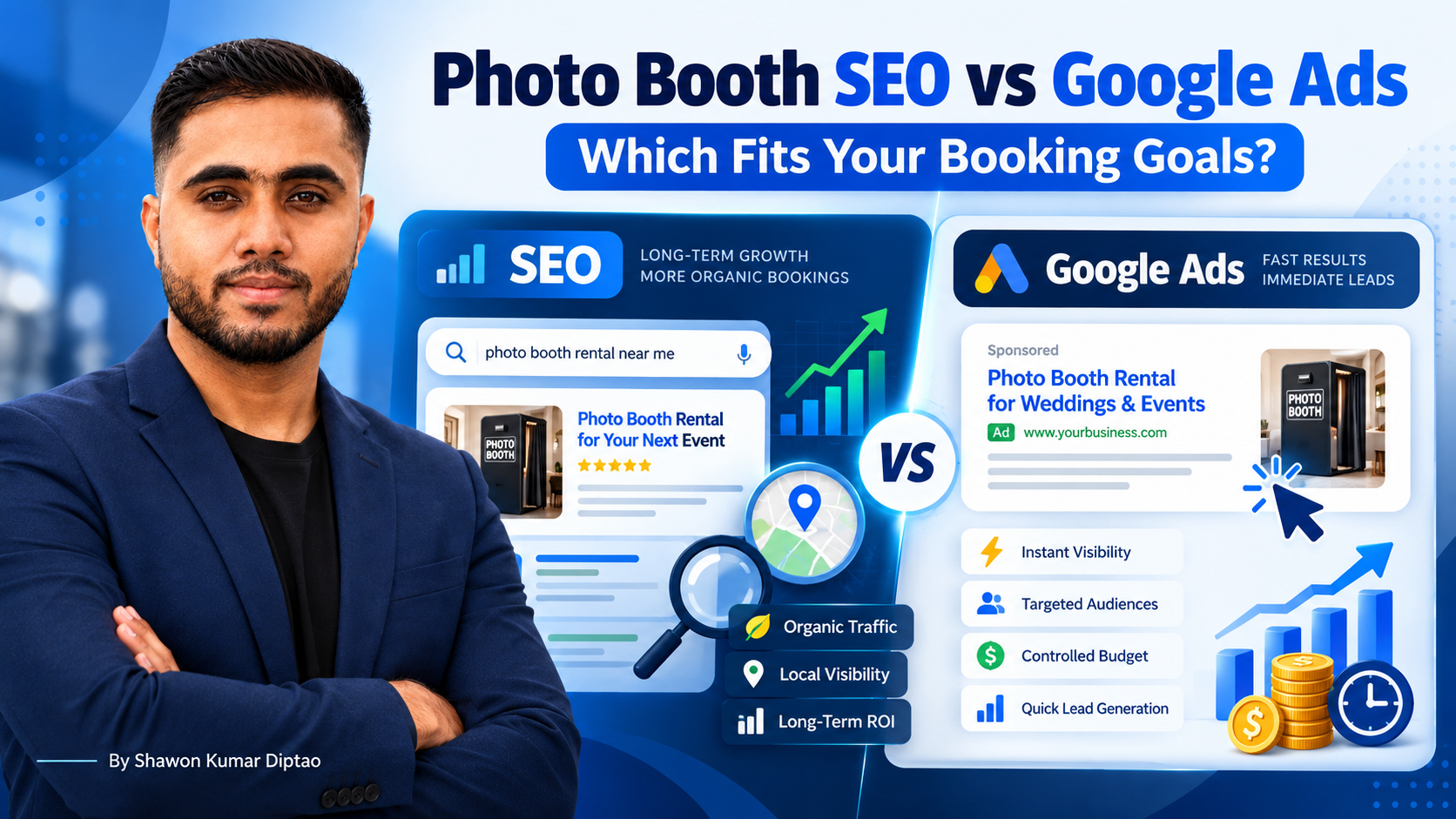
Photo Booth SEO vs Google Ads: Which Fits Your Booking Goals?
By Shawon Kumar Diptao | SEO Consultant, AI SEO Strategist & Local SEO Specialist
If you need more photo booth bookings quickly, Google Ads can help you reach people actively searching for rental services. If you want to build a more sustainable source of enquiries over time, search engine optimization (SEO) is the stronger long-term foundation. For many photo booth rental businesses, combining both channels is the most practical approach.
The right choice depends on how soon you need bookings, how competitive your market is, what you can afford to spend acquiring a customer, and whether your website converts visitors into paying clients.
The important question is not simply which channel generates more clicks. It is which channel brings qualified enquiries that turn into profitable bookings at a cost your business can sustain.
Photo Booth SEO vs Google Ads: The Quick Answer
Choose Google Ads when you need faster visibility for high-intent searches and have the budget, landing page, and follow-up process to convert enquiries into bookings.
Choose SEO when you want to build organic visibility, strengthen your website and Google Business Profile, answer customer questions, and develop a source of enquiries that does not depend entirely on paying for every click.
Use both when you need short-term demand capture alongside long-term growth.
| Booking goal | Better starting point | Why |
|---|---|---|
| Generate enquiries quickly | Google Search Ads | Your business can appear for relevant searches once the campaign is eligible to serve |
| Build long-term organic visibility | SEO | Useful service pages, local relevance, and website improvements can continue attracting organic traffic |
| Test which services customers want | Google Ads, supported by keyword research | Campaign data can help reveal which search themes attract qualified enquiries |
| Improve Google Maps visibility | Local SEO and Google Business Profile optimization | These activities strengthen your local search presence |
| Reduce dependence on paid traffic | SEO | Organic visibility provides another acquisition channel |
| Fill seasonal booking gaps | Google Ads, supported by SEO | Paid campaigns can target current demand while organic visibility develops |
| Build a balanced booking pipeline | SEO + Google Ads | The channels can support different stages of customer acquisition |
These are starting recommendations, not guarantees. Actual performance depends on search demand, competition, service area, website quality, advertising costs, and your ability to convert enquiries into bookings.
What Is the Difference Between Photo Booth SEO and Google Ads?
Although both channels can bring customers from Google, they work differently.
How photo booth SEO works
Photo booth SEO improves your website and online presence so potential customers can discover your business through unpaid search results.
A practical SEO strategy may include:
- Researching commercial keywords such as “photo booth rental,” “wedding photo booth rental,” and “360 photo booth rental.”
- Creating useful service pages for the booth types and events you genuinely serve.
- Improving titles, headings, internal links, website structure, and technical accessibility.
- Optimizing your Google Business Profile and maintaining accurate business information.
- Building trust with authentic event photographs, customer reviews, package details, and clear service information.
- Publishing helpful content that answers customers’ questions before they request a quote.
- Making your business and services easier for search engines and AI-powered discovery systems to understand.
SEO is not simply adding keywords to a website. It is about making your business relevant to the searches customers use, helping them evaluate your offer, and making the next step straightforward.
Google’s people-first content guidance emphasizes useful, reliable content created to benefit people rather than pages produced primarily to manipulate rankings.
The main advantage: SEO can build lasting organic visibility and reduce your dependence on paid clicks.
The main limitation: Results are not immediate or guaranteed. Building meaningful visibility often takes months, depending on competition, your starting position, and the work required.
How Google Ads works for photo booth rentals
Google Search Ads let you pay to appear for eligible searches relevant to your services.
For example, a potential customer might search for:
- Photo booth rental near me
- Wedding photo booth rental
- Corporate event photo booth rental
- 360 photo booth rental
- Photo booth rental packages
With suitable targeting and a relevant landing page, your advertisement can put your offer in front of someone already looking for a provider.
You generally pay for advertising interactions according to your campaign’s bidding and billing arrangements. Paying for a click does not mean you have paid for a qualified enquiry or a confirmed booking.
A successful campaign needs more than an advertising budget. It needs relevant keywords, appropriate targeting, a clear offer, conversion tracking, and timely follow-up.
Google explains how Search campaigns can target people actively searching for products and services in its official Search campaign guide.
The main advantage: Google Ads can create visibility quickly once a campaign is approved and eligible to serve.
The main limitation: Advertising can consume your budget without generating profitable bookings if targeting, landing pages, tracking, or sales follow-up are weak.
Organic vs Paid Photo Booth Leads: Which Are Better?
Neither organic nor paid leads are automatically better. Lead quality depends on the customer’s intent, your targeting, your offer, and how well your business fits the customer’s requirements.
Consider two examples.
Organic lead: Someone searches for wedding photo booth ideas, finds your guide, explores your wedding service page, checks your photographs, and requests a quote.
Paid lead: Someone searches for a corporate photo booth rental, clicks your advertisement, reviews your corporate package, and submits an enquiry.
Both leads can become valuable customers. However, the first journey may involve several visits and a longer research period, while the second may be more direct.
Here is how the channels compare.
| Factor | Organic leads from SEO | Paid leads from Google Ads |
|---|---|---|
| Customer intent | Can range from early research to immediate booking | Can be highly commercial when campaigns target relevant rental searches |
| Cost structure | SEO labour, content, technical work, tools, and ongoing maintenance | Advertising spend plus any management, landing page, and tracking costs |
| Speed | Usually builds over time | Visibility can begin soon after launch and approval |
| Long-term value | Strong pages can continue attracting visitors, although rankings and demand change | Traffic generally depends on continued campaign delivery and budget |
| Targeting | Search intent, relevant content, local relevance, and service-page structure | Campaign settings, keywords, search terms, location targeting, and bidding |
| Measurement | Search Console, analytics, enquiry records, and booking data | Ad reports, conversion tracking, enquiry records, and booking data |
| Main risk | Investing in traffic that does not match commercial intent | Paying for irrelevant clicks or leads that do not convert |
For a photo booth business, the useful comparison is not organic leads versus paid leads in isolation. It is the cost and value of the confirmed bookings each channel produces.
A channel that delivers fewer enquiries may still be better if those enquiries convert more often or generate higher-value events.
Which Channel Fits Your Current Booking Goals?
The right photo booth marketing channels depend on your business’s current position.
1. You need bookings in the near term
Start by evaluating Google Search Ads if there is sufficient relevant search demand and you can afford to test a campaign.
Focus on searches that demonstrate rental intent rather than general interest in photo booths. For example, “corporate photo booth rental” is more directly connected to hiring a provider than “how does a photo booth work?”
Before launching, prepare a dedicated landing page with:
- The booth types and events you serve.
- Clear package information or useful pricing context.
- Authentic photographs of your setups.
- Reviews and other genuine trust signals.
- Your actual service coverage.
- A prominent quote request or booking enquiry form.
- A clear explanation of what happens after the customer enquires.
Make sure someone can respond to enquiries promptly. A good advertisement cannot compensate for an unclear offer or a slow sales process.
SEO should not be ignored while you run ads. Start improving your service pages, website structure, and local presence so you are building an organic acquisition channel at the same time.
2. You want more consistent bookings over time
Prioritize SEO if your goal is to establish a stronger, less advertising-dependent source of enquiries.
Start with the pages most likely to support a booking:
- Main photo booth rental service page.
- Wedding photo booth rental page, if offered.
- Corporate event photo booth page, if offered.
- 360 photo booth rental page, if offered.
- Genuine service-area pages where each page can provide useful, distinct information.
- Package, pricing, and frequently asked questions content.
Do not create a separate page for every minor keyword variation. Create pages when customers have meaningfully different needs and would benefit from dedicated information.
Your Google Business Profile also deserves attention if you serve customers locally. Accurate business details, relevant services, real photographs, reviews, and a well-structured website can help potential customers evaluate your business.
For guidance on this area, see my article on how photo booth rental companies can improve local SEO.
3. You have seasonal demand or uneven enquiries
Consider using both channels with different responsibilities.
For example, before a busy wedding season, a photo booth company might use Google Ads to capture immediate searches for wedding rentals while improving its wedding service page, Google Business Profile, and supporting content.
When demand slows, the business can review which searches, pages, and services generated profitable bookings and refine its organic strategy.
The goal is not to keep spending simply because a campaign is running. It is to use paid advertising where the economics make sense while continuing to improve the business’s long-term visibility.
4. You are launching a new photo booth business
A new business may benefit from a limited, carefully measured Google Ads test while establishing its organic foundations.
Ads can help you test the relevance of different service offers and search themes, but a small or poorly measured campaign cannot establish reliable demand on its own.
At the same time, build a credible website, publish clear service information, establish your Google Business Profile where eligible, collect genuine reviews as you earn them, and make your enquiry process easy to use.
Avoid committing a large budget before you know your approximate cost per qualified lead, lead-to-booking rate, and maximum affordable customer acquisition cost.
How Much Should You Spend on SEO vs Google Ads?
There is no universal budget that works for every photo booth rental business. The appropriate amount depends on your market, average booking value, service costs, competition, available demand, and business goals.
The most useful starting point is to work backwards from the economics of a booking.
Calculate your maximum affordable acquisition cost
Use this formula:
Maximum affordable acquisition cost = contribution per booking − contribution you need to retain after acquisition
Contribution per booking means the booking revenue remaining after variable fulfilment costs, before marketing and other overheads.
For example, suppose a photo booth package sells for $900 and the variable cost of delivering the event is $350.
That leaves $550 before marketing and other overheads.
If you need to retain $250 from that contribution, your maximum affordable acquisition cost is $300.
These figures are illustrative, not industry benchmarks. Your actual costs, overheads, and profit requirements will determine your own threshold.
Calculate the cost of paid bookings
Suppose a hypothetical campaign spends $300 and generates five qualified enquiries. If one of those enquiries becomes a confirmed booking, the advertising cost per booked event is $300.
The cost per qualified lead is $60, but the cost per booked event is $300.
That difference matters.
A campaign may appear affordable when measured by enquiries but become unprofitable when measured by confirmed bookings.
Calculate the cost of organic bookings
For SEO, divide the relevant SEO investment over a defined period by the number of confirmed bookings attributed to organic search during that period.
For example, if a business invests $600 in SEO-related work in a month and receives four attributable organic bookings, the simple monthly cost per organic booking is $150.
This is only an illustrative calculation. SEO investment can build assets that produce value beyond a single month, and organic bookings may follow earlier work. Avoid comparing a mature organic channel with a newly launched paid campaign as if they were at the same stage.
For both channels, account for the costs you can reasonably attribute, including labour, management, content, tools, and landing page work.
The decision rule: Choose the channel based on sustainable cost per booked event and the value those bookings generate—not on the cheapest click or the largest number of enquiries.
How to Measure Which Channel Actually Produces More Bookings
If you cannot connect enquiries to confirmed bookings, you cannot reliably determine which marketing channel is performing best.
I recommend a simple measurement process that connects search visibility to commercial outcomes.
Step 1: Track meaningful enquiries
Record the actions that indicate genuine interest, such as:
- Completed quote request forms.
- Calls from prospective customers.
- Relevant booking enquiries.
- Requests for a package or event-specific quote.
Track these actions consistently across both channels. Avoid treating every page view or casual interaction as a business result.
Step 2: Record the source of each enquiry
Use analytics and your enquiry management process to identify whether a lead came from organic search, a paid advertisement, another referral source, or an unknown source.
Where possible, record the campaign, landing page, event type, enquiry date, and booking status.
Google’s conversion measurement documentation explains how conversion tracking can help advertisers identify which campaigns, ads, and keywords drive valuable customer actions.
Step 3: Follow the lead through to the booking
Your records should distinguish between:
- New enquiry.
- Qualified lead.
- Quote sent.
- Booking confirmed.
- Revenue collected or event completed, where relevant.
This prevents a high volume of low-quality enquiries from making a weak campaign look successful.
Step 4: Review performance using the right tools
Use Google Search Console to review organic search impressions, clicks, queries, and pages. Use Google Analytics to understand website behaviour and conversions where tracking is configured.
For paid search, review spend, search terms, conversion data, and cost per qualified lead. Google Ads’ Search campaign optimization guidance explains the role of conversion rate and conversion value in assessing campaign performance.
Reconcile these reports with your own booking records. Platform reports and actual business outcomes are related, but they are not interchangeable.
Step 5: Improve the channel causing the biggest problem
Use the data to diagnose the problem.
- Few relevant impressions: Review demand, keyword coverage, targeting, and eligibility.
- Impressions but few clicks: Improve relevance and how your offer appears in search results.
- Clicks but few enquiries: Review the landing page, trust signals, pricing clarity, and enquiry process.
- Many enquiries but few bookings: Investigate lead quality, package fit, response time, and follow-up.
- Bookings at an unsustainable cost: Reassess acquisition costs, targeting, margins, and the channel mix.
This research-first approach reflects my core SEO philosophy: understand what is preventing growth before deciding which optimization to make.
Should You Combine Photo Booth SEO and Google Ads?
For many businesses, yes—but the channels should have distinct roles rather than competing for the same budget without a plan.
A practical combined strategy has four parts.
1. Build the conversion foundation. Make your service information clear, show authentic work, explain packages, and create a simple way to request a quote. Configure enquiry and booking tracking before scaling marketing spend.
2. Use Google Ads to test relevant demand. Start with a controlled budget and commercially relevant searches. Review actual search terms and exclude irrelevant searches using negative keywords. Google’s search terms report guidance explains how the report can help identify negative keyword opportunities.
3. Build organic visibility around real customer needs. Improve core service pages, local search signals, and helpful content. Prioritize topics that support the booking decision instead of publishing articles simply to increase website traffic.
4. Allocate resources using booking data. Compare qualified enquiries, confirmed bookings, acquisition costs, and booking value. Increase investment only when performance and capacity justify it.
SEO, Local SEO, and AI-search optimization can work together when they improve the clarity, usefulness, credibility, and structure of your business information. These improvements may help search engines and AI systems interpret your services, but no strategy can guarantee a particular ranking or inclusion in an AI-generated answer.
Common Mistakes That Waste Photo Booth Marketing Budgets
Choosing a channel based on clicks alone
Clicks indicate attention, not profitability. Measure qualified enquiries and confirmed bookings.
Sending every advertisement to the homepage
A customer looking for a wedding booth should land on a page that addresses wedding-specific needs. A corporate customer may need different packages, branding options, or event information.
Targeting searches unrelated to rentals
Broad targeting can attract people researching equipment, DIY setups, employment, or other topics that do not match your service. Review search terms and exclude irrelevant traffic.
Expecting SEO to produce immediate results
Organic search visibility takes time to build and can fluctuate. SEO should be evaluated against an appropriate time horizon, not judged solely on the first few weeks.
Treating SEO as free marketing
Organic clicks do not carry the same per-click advertising charge, but SEO still requires investment in research, content, technical work, local optimization, and maintenance.
Ignoring lead follow-up
An enquiry is not a booking. Slow responses, unclear pricing, and inconsistent follow-up can undermine both paid and organic acquisition.
Overlooking local search
If your business serves a defined area, your website and Google Business Profile should make your services, genuine coverage, and contact options easy to understand.
How I Would Choose the Right Channel for Your Business
As Shawon Kumar Diptao, an SEO Consultant, AI SEO Strategist, and Local SEO Specialist, I approach this decision by looking at the complete customer journey rather than recommending a channel simply because it is popular.
My process starts with understanding your services, target customers, competition, website, current visibility, and business goals. I then identify what is preventing growth and prioritize actions according to their likely commercial value.
For a photo booth rental business, that means connecting:
- Search intent with the right service pages.
- Local visibility with genuine service coverage.
- Website content with the questions customers need answered before booking.
- Google Ads data with lead quality and booking outcomes.
- SEO, Answer Engine Optimization (AEO), and Generative Engine Optimization (GEO) with clear, trustworthy business information.
- Reporting with practical decisions about where to invest next.
The objective is not to chase rankings, traffic, or advertising clicks as isolated metrics. It is to help the right customers discover your business, understand your offer, trust your services, and take the next step.
The best strategy will depend on your current position. A business with a strong website but low immediate demand may need a different plan from one receiving plenty of traffic but very few enquiries.
Frequently Asked Questions
Is SEO better than Google Ads for a photo booth business?
SEO is generally better suited to building long-term organic visibility, while Google Ads can provide faster paid visibility for relevant searches. Neither is automatically more profitable. Compare the qualified leads, confirmed bookings, and acquisition costs each channel produces.
How long does photo booth SEO take to generate bookings?
There is no guaranteed timeline. Results depend on your website’s starting condition, competition, search demand, local visibility, and implementation. Treat SEO as an ongoing investment and monitor progress through search performance, qualified enquiries, and bookings.
How much should a photo booth business spend on Google Ads?
Set your budget according to your available cash flow, relevant search demand, and maximum affordable acquisition cost. Start with a controlled test, measure qualified leads and bookings, and avoid increasing spend simply because clicks are inexpensive.
Are organic photo booth leads free?
No. You do not generally pay Google for an organic click, but earning and maintaining organic visibility requires investment in strategy, content, website improvements, local SEO, and ongoing work.
Can Google Ads and SEO target the same keywords?
Yes. Both channels can support visibility for similar searches. Ads may help capture demand while organic visibility develops. Measure their combined performance carefully, and do not assume every paid click would otherwise have become an organic visit or booking.
What should I track to compare SEO and Google Ads?
Track qualified enquiries, confirmed bookings, cost per booked event, booking value, and—where your records allow—contribution after variable fulfilment costs and marketing. Use Search Console for organic search performance, analytics for website behaviour, Google Ads conversion tracking for paid campaigns, and booking records to evaluate business outcomes.
Ready to Improve Your Photo Booth Booking Strategy?
If your photo booth rental business is getting traffic but not enough enquiries, spending on ads without seeing profitable bookings, or struggling to build organic visibility, the first step is to identify where the booking journey is breaking.
I can help you review your website, search visibility, competitors, local SEO, content, and conversion opportunities, then develop a practical plan based on your goals and current performance.
Contact Shawon Kumar Diptao for a free SEO growth review to discuss your website, your booking goals, and whether SEO, Google Ads, or a combination of both makes the most sense for your business.