Which Is Better: GEO vs Traditional SEO for Local Businesses Trying to Rank in Google AI Overviews?
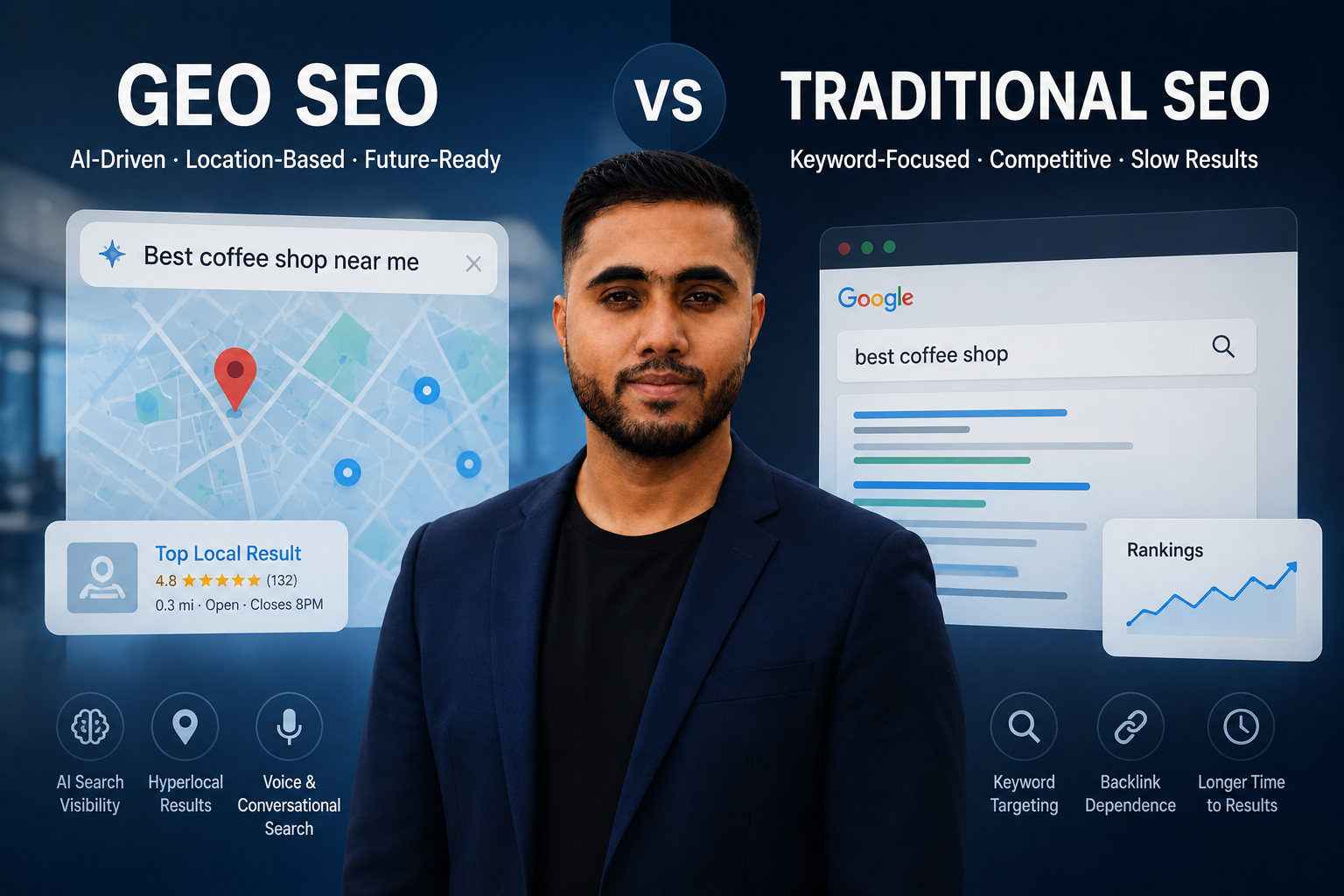
For most local businesses, traditional SEO is still the foundation, but GEO is now essential for businesses that want to appear in Google AI Overviews and AI-powered search results. So, which is better GEO vs traditional SEO for local businesses? The best answer is both. Traditional SEO helps your website rank on Google, while GEO helps your content become clear, trustworthy, and useful enough for AI search engines to summarize or recommend.
Local businesses should not treat GEO and traditional SEO as competitors. Instead, they should use them together. Traditional SEO builds your visibility through keyword targeting, website optimization, service pages, backlinks, reviews, and Google Business Profile improvements. GEO, also called Generative Engine Optimization, makes your content easier for AI systems to understand, extract, and present as a helpful answer.
If your goal is to increase local visibility, rank for long-tail questions, appear on Google, show up in Google AI Overviews, and support your main service pages with internal links, then combining GEO and traditional SEO is the smartest strategy.
At Shawon Kumar Diptao, the focus is on creating SEO strategies that help local businesses rank in today’s search results while preparing for the future of AI-driven search.
GEO vs Traditional SEO: Quick Comparison for Local Businesses
| Factor | Traditional SEO | GEO |
|---|---|---|
| Main Goal | Rank higher on Google | Get mentioned or summarized in AI answers |
| Best For | Service pages, local rankings, organic traffic | Google AI Overviews, answer engines, long-tail questions |
| Content Style | Keyword-focused and search-focused | Answer-focused and entity-focused |
| Local Benefit | Improves visibility in local search | Helps AI understand your local relevance |
| Best Strategy | Build authority and rankings | Make content clear, structured, and quotable |
Traditional SEO helps your local business become visible. GEO helps your business become understandable to AI systems. A local business that wants long-term growth needs both.
What Is Traditional SEO for Local Businesses?
Traditional SEO is the process of optimizing your website so it can rank higher in search engines like Google. For local businesses, this usually includes local SEO, service page optimization, technical SEO, content marketing, backlinks, online reviews, and Google Business Profile optimization.
For example, a local service business may want to rank for searches like:
- “SEO services for local businesses”
- “marketing consultant for small business”
- “how to rank higher on Google”
- “why is my business not showing on Google”
- “best SEO strategy for local visibility”
Traditional SEO helps Google understand what your business offers, who you serve, and why your website should appear above competitors.
A strong traditional SEO strategy usually includes:
- Optimized service pages
- Helpful blog content
- Internal linking
- Local keyword targeting
- Fast website loading speed
- Mobile-friendly design
- Schema markup
- High-quality backlinks
- Google Business Profile optimization
- Customer reviews and reputation signals
Traditional SEO is especially important because AI search systems still depend on well-structured, crawlable, trustworthy web content. If your website has weak pages, poor structure, or unclear service information, GEO alone will not solve the problem.
What Is GEO in SEO?
GEO stands for Generative Engine Optimization. It is the process of optimizing content so generative AI systems, answer engines, and AI search experiences can understand and use your content in responses.
In simple terms, traditional SEO asks, “Can this page rank on Google?”
GEO asks, “Can an AI system understand this page well enough to use it in an answer?”
That difference matters because people now search with longer, more conversational questions. Instead of typing only “SEO service,” they may ask:
- “Which is better GEO vs traditional SEO for local businesses?”
- “How can my local business rank in Google AI Overviews?”
- “Do I still need traditional SEO if AI search is growing?”
- “What kind of content gets used in AI search results?”
- “How do I make my service pages more visible in Google?”
GEO helps answer these questions clearly. It focuses on direct answers, structured content, expert explanations, FAQs, topical authority, entity clarity, and trust signals.
For local businesses, GEO is useful because it helps your content match how real customers ask questions before making a buying decision.
Which Is Better GEO vs Traditional SEO for Local Businesses?
The better option depends on your current situation.
If your website is not ranking, your service pages are weak, your Google Business Profile is incomplete, or your business has low local visibility, traditional SEO should come first.
If your website already has decent rankings but you are not appearing in Google AI Overviews, featured snippets, or long-tail answer-based searches, GEO should become a priority.
However, the best strategy is to use both together.
Traditional SEO builds the foundation. GEO improves how your content performs in AI-powered search.
Think of it this way:
Traditional SEO helps Google find and rank your website. GEO helps AI systems understand and explain your content.
For local businesses, this combination is powerful because it supports both search visibility and buyer education. A potential customer may first find your blog post through a long-tail question, then click through to your main service page using an internal link. That is how SEO content supports conversion.
For example, this blog post can support a main SEO service page by linking readers to Shawon Kumar Diptao for SEO and GEO strategy support.
Why Local Businesses Need Both SEO and GEO
Local businesses face unique challenges. They are not only competing for broad keywords. They are competing for trust, relevance, and visibility in their service area.
A local customer does not always search in a simple way. They may search based on a problem, price concern, comparison, or urgent need.
Common local search examples include:
- “Why is my business not ranking on Google?”
- “How much does local SEO cost?”
- “Is SEO worth it for small businesses?”
- “Can AI Overviews help local businesses get leads?”
- “Should I invest in GEO or traditional SEO?”
- “How do I improve local visibility without paid ads?”
These searches show strong intent. Some users are researching. Others are close to hiring a professional.
Traditional SEO helps you rank for these searches. GEO helps your content answer them in a way that AI systems and users can easily understand.
A local business that only focuses on traditional SEO may miss opportunities in AI search. A business that only focuses on GEO may struggle because it lacks the technical and authority foundation needed to rank.
That is why the winning approach is not GEO vs traditional SEO. It is GEO plus traditional SEO.
How GEO Helps Local Businesses Rank in Google AI Overviews
Google AI Overviews are designed to provide quick, helpful answers to searchers. To have a better chance of being included or referenced, your content needs to be easy to understand and highly useful.
GEO helps by improving the structure and clarity of your content.
A GEO-ready page should include:
- A direct answer near the beginning
- Clear H2 and H3 headings
- Question-based subheadings
- Short, helpful explanations
- Expert insight
- Real-world examples
- FAQs
- Schema markup
- Trust signals
- Internal links to relevant service pages
For example, instead of writing a vague heading like “SEO Information,” a GEO-focused heading would be:
“Which Is Better GEO vs Traditional SEO for Local Businesses?”
That heading matches the exact question a searcher may ask. It also helps AI systems identify the main topic quickly.
GEO also improves answer extraction. If your content provides a clear definition, comparison table, checklist, and FAQ section, it becomes easier for search engines and AI systems to understand the value of your page.
How Traditional SEO Supports Local Rankings
Traditional SEO remains important because it builds the signals that search engines use to rank your website.
For local businesses, traditional SEO supports:
- Organic rankings
- Google Maps visibility
- Website traffic
- Service page authority
- Local relevance
- Brand trust
- Lead generation
A well-optimized local business website should have strong service pages. Each service page should target a specific keyword and explain the service clearly. Blog posts should then support those service pages through internal links.
For example, a blog post about GEO vs traditional SEO for local businesses should link to a main SEO service page. This helps Google understand that the blog post supports the service offering. It also helps readers take the next step.
Traditional SEO also includes technical factors. If your website is slow, hard to navigate, not mobile-friendly, or missing important metadata, your rankings may suffer.
Before investing heavily in GEO, make sure your traditional SEO foundation is strong.
Cost of GEO vs Traditional SEO for Local Businesses
The cost of GEO and traditional SEO depends on your website, competition, content needs, and business goals.
Traditional SEO costs are often affected by:
- Website size
- Number of service pages
- Technical SEO issues
- Local competition
- Content requirements
- Backlink needs
- Google Business Profile optimization
- Review strategy
- Ongoing reporting
GEO costs are often affected by:
- Existing content quality
- Number of pages needing updates
- FAQ creation
- Schema implementation
- Content restructuring
- Entity optimization
- AI Overview-focused content planning
- Topical authority development
Traditional SEO may require more technical work and authority building. GEO may require more content restructuring and answer optimization.
For many local businesses, the most cost-effective strategy is to start with an SEO audit. This shows what is missing and where the biggest opportunities are. Then the business can improve service pages, create supporting blog content, and optimize for AI search over time.
If budget is limited, start with traditional SEO basics first. Then add GEO improvements to your most important pages.
Common Problems Local Businesses Face With SEO and GEO
Many local businesses struggle because their website content is too generic. It may explain the service, but it does not answer the real questions customers are asking.
For example, a generic page may say:
“We provide SEO services for businesses.”
A stronger SEO and GEO-friendly page would explain:
- What SEO services include
- Who the service is for
- What problems it solves
- How the process works
- What results to expect
- How long SEO takes
- How much SEO may cost
- Why expert help matters
- How the service supports local visibility
Another common problem is weak internal linking. Blog posts may get traffic, but they do not guide readers toward service pages. This is a missed opportunity.
Your blog content should support your main service pages. Every educational post should have a clear next step, such as contacting an expert, requesting an audit, or visiting a service page.
Local businesses also struggle when they use AI-generated content without expert editing. Content that sounds generic, repetitive, or unsupported may not build trust. GEO requires clarity, but it also requires experience and authority.
Local SEO and GEO Checklist
Use this checklist to review your website:
- Does each page answer the main question clearly?
- Is the target keyword used naturally?
- Does the page include local business context?
- Are service pages linked from relevant blog posts?
- Are FAQs included for AEO and AI search?
- Is the content written for real customers, not only algorithms?
- Does the page include expert advice or examples?
- Is the website fast and mobile-friendly?
- Is your Google Business Profile optimized?
- Are you updating old content regularly?
If you answered “no” to several of these, your business may need both traditional SEO and GEO improvements.
How to Target Nearby Areas Without Stuffing Location Keywords
Since this strategy does not require mentioning a specific city, your content can still be GEO-focused by using natural service-area language.
Instead of forcing city names into every heading, use phrases like:
- local businesses
- your service area
- nearby customers
- local market
- businesses in your area
- local search visibility
- regional competitors
- service-based businesses
This keeps the content natural while still supporting local ranking goals.
You can also build geographic relevance through:
- Service-area pages
- Customer case studies
- Local reviews
- Location-specific FAQs
- Google Business Profile updates
- Locally relevant blog topics
- Internal links to service pages
The key is to make the content useful, not stuffed with location terms. Search engines and AI systems are better at understanding context than ever before.
Maintenance Tips for Long-Term SEO and GEO Results
SEO and GEO are not one-time tasks. Search behavior changes. Competitors update their websites. Google changes how results appear. AI Overviews continue to evolve.
To maintain results, local businesses should update their content regularly.
Important maintenance steps include:
Update Service Pages Quarterly
Review your main service pages every few months. Add new examples, update outdated information, improve headings, and include stronger calls to action.
Refresh FAQs Based on Real Customer Questions
If customers ask the same questions during calls or emails, add those questions to your website. This improves AEO and helps your content match long-tail searches.
Improve Internal Links
Make sure blog posts link to relevant service pages. This helps users navigate your website and helps Google understand your content structure.
Monitor Search Performance
Use tools like Google Search Console to see which pages get impressions but low clicks. Those pages may need better titles, meta descriptions, introductions, or CTAs.
Add Expert Insight
Do not publish generic content only. Add expert tips, warnings, checklists, and practical examples. This improves trust and usefulness.
When to Call a Professional for GEO and Traditional SEO
You should call a professional if your website is not ranking, your traffic has dropped, your service pages are not converting, or your competitors are appearing more often in AI search results.
You should also get help if you are unsure how to connect blog content with your main service pages. Many local businesses publish blogs but do not use them strategically. A blog should educate, rank, and support conversions.
A professional can help you:
- Audit your current SEO performance
- Improve your service pages
- Create GEO-ready blog content
- Optimize for Google AI Overviews
- Build internal linking structures
- Fix technical SEO issues
- Improve local search visibility
- Create a long-term content strategy
If you want SEO content that supports both Google rankings and AI search visibility, working with an expert can save time and prevent costly mistakes.
Why Choose Shawon Kumar Diptao?
Shawon Kumar Diptao helps businesses build SEO strategies that are designed for modern search. The goal is not only to rank for keywords but also to create helpful, structured, and trustworthy content that supports local visibility and AI search performance.
With Shawon Kumar Diptao, your SEO strategy can include traditional SEO, GEO, AEO-friendly content, service page support, internal linking, and long-tail keyword targeting.
This approach is especially valuable for local businesses that want to rank on Google, appear in Google AI Overviews, answer customer questions, and turn website visitors into leads.
Instead of publishing random blog posts, Shawon Kumar Diptao focuses on strategic content that supports your main business goals.
Final Answer: GEO or Traditional SEO?
So, which is better GEO vs traditional SEO for local businesses?
Traditional SEO is better for building your foundation. GEO is better for improving your visibility in AI-powered search and answer-based results. But the strongest strategy is using both together.
Traditional SEO helps your website rank. GEO helps your content get understood. Together, they help your local business increase visibility, answer customer questions, support service pages, and compete in both Google Search and Google AI Overviews.
If your business wants to improve local visibility and prepare for the future of search, now is the right time to combine traditional SEO with GEO.
Ready to build a smarter SEO strategy? Visit Shawon Kumar Diptao to get support with SEO, GEO, and AI-ready content strategy.
FAQs About GEO vs Traditional SEO for Local Businesses
1. Which is better GEO vs traditional SEO for local businesses?
Traditional SEO is better for building rankings, traffic, and local visibility. GEO is better for helping content appear in AI-generated answers like Google AI Overviews. Local businesses should use both together for the best results.
2. Can GEO help my business rank in Google AI Overviews?
Yes. GEO can help by making your content clearer, more structured, and easier for AI systems to understand. Direct answers, FAQs, expert insights, and strong internal links can improve AI search readiness.
3. Do local businesses still need traditional SEO?
Yes. Local businesses still need traditional SEO because it helps Google crawl, understand, and rank their websites. GEO should enhance traditional SEO, not replace it.
4. How do I make my website GEO-friendly?
To make your website GEO-friendly, answer important questions clearly, use structured headings, add FAQs, include expert advice, use schema markup, and connect blog posts to your main service pages with internal links.
5. Is GEO more expensive than traditional SEO?
GEO is not always more expensive. The cost depends on how much content needs to be created or updated. Traditional SEO may require more technical work, while GEO often focuses on content structure, clarity, and answer optimization.
6. How long does it take to see results from SEO and GEO?
Traditional SEO often takes several months to show meaningful results. GEO improvements may help content become clearer and more competitive for long-tail questions, but results still depend on authority, competition, content quality, and indexing.
7. Who can help with GEO and traditional SEO strategy?
Shawon Kumar Diptao can help local businesses create SEO and GEO strategies designed to improve Google rankings, support AI Overview visibility, and strengthen service page performance.